All from George Cruikshank, Click for full size! (Most below the fold.)
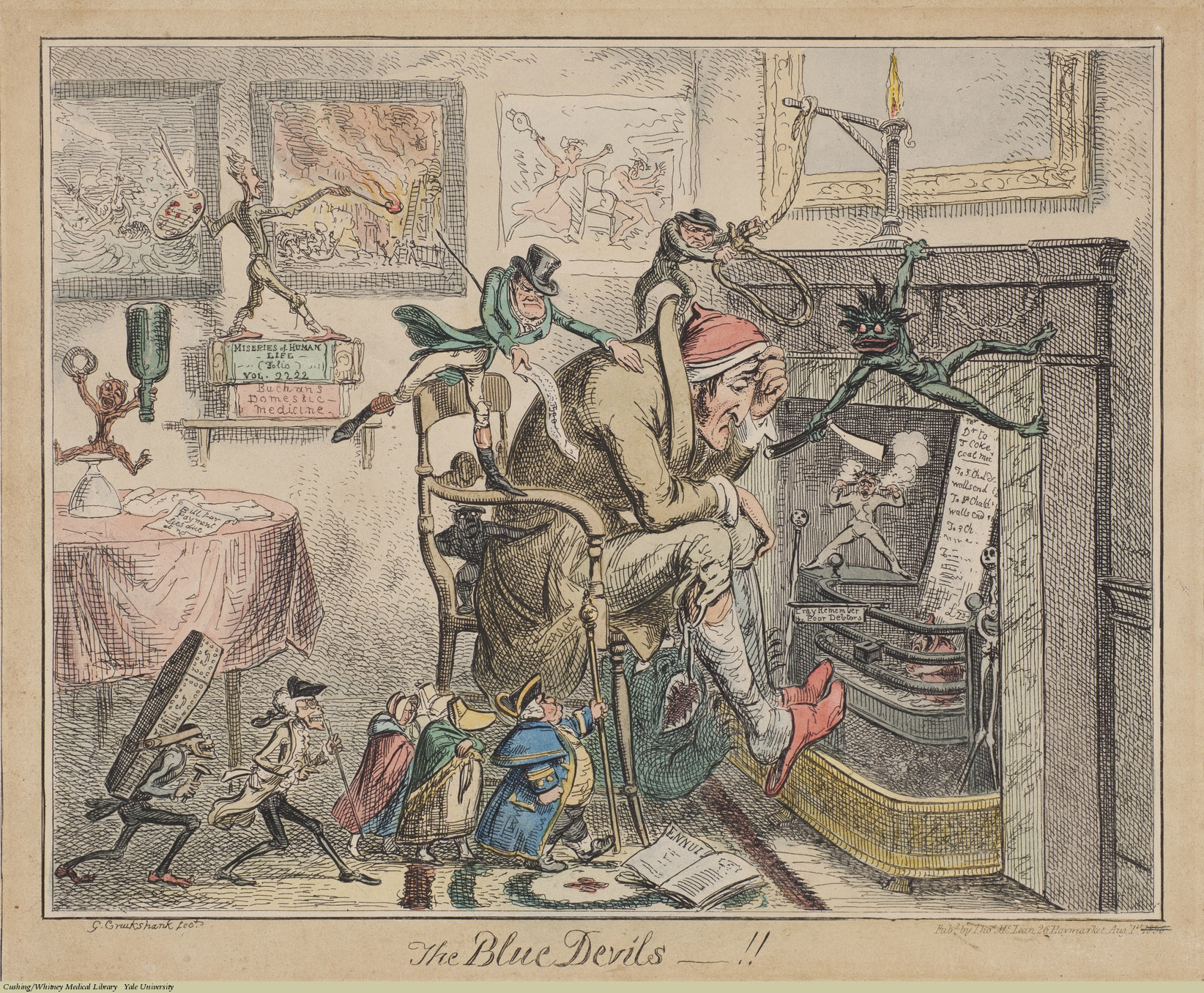
Blue Devils, George Cruikshank, Etching. Subject: Depression, Suicide, Devils & Demons.

All from George Cruikshank, Click for full size! (Most below the fold.)
Blue Devils, George Cruikshank, Etching. Subject: Depression, Suicide, Devils & Demons.
There will be much of George Cruikshank, caricaturist and printmaker coming up, but I felt this one deserved to be on its own, given the sheer amount of very weird detail. There seems to be an implication of witchery and/or paganism here. Interestingly, this one was one of the ones designed by Frederick Marryat, a British naval officer, and author. It’s interesting to note that In 1839, Marryat also published his Diary in America, a travelogue that reflects his criticisms of American culture and society. The book and the author were both subject to acts of violence, including the burning of the book and of Marryat’s effigy in public. It can be read for free at the link provided; I note that the e-books are also available through Barnes & Noble and Amazon.
There’s an astonishing amount of detail here. Note the painting hanging on the wall – an assault in progress. That earns a WTF? Then the Goddess detail on the mantel, with the dogs. Peacock feathers on the mantel, too. They were associated with witches, particularly those with healing arts. Then there’s the cat and dog, and screaming parrot, with the mouse in between. And what appears to be a Buddha on the mantel, and so. much. more. Click for full size!

The last of Louis-Léopold Boilly for now. The second month and the ninth month of pregnancy.


This is the last drawing in the Anatomy atlas that is about skeleton.
Pelvis is most ingenous in many ways. Not only is the hip joint bearing most of the weight, it is second most flexible joint in human body, with three axes of freedom just like the shoulder joint, only in lesser degree. Further the whole structure must be flexible enough to allow for birth.

©Charly, all rights reserved. Click for full size.
Today’s stories ar more sad than interesting and they are both about the skeleton we used for learning.
When teaching assistant brought the box with skeleton in the class her emphasised ” These are not casts, these are real bones. Please be aware that you are handling the remains of a real human being, so treat them with dignity. Memento mori – you too shall perish.”.
I was wondering why he feels the need to say that, we are all adults over twenty years of age, surely we need not be reminded of that like some adolescents? Well, not long after he has left the class one future gym teacher was showing off in front of a few of his laughing female classmates with a femur used as a microphone for pretend singing. My opinion of them all dropped significantly and I never forgot that sight. That was one of many proofs that in every social gathering will inevitably be someone who insist on being an asshole and someone who enables them in being an asshole.
Second story is about the dead man himself. He did not have completely fused os sacrum, with the top vertebra being free. And his whole pelvis was assymetrical and deformed on one side, with the openning for nervus ischiadicus being pinched and ground between that free vertebra and the fused rest. The teaching assistant told us that the man must have suffered from immense pain his whole life and that this was assumed to be the reason why he dies at relatively young age with probable cause of death being suicide by means of unknown poison. Whenever I remember that story I wish he had better options to deal with that problem.
I was happily lost in The Public Domain Review the other day, and came across High Frequency Electric Currents in Medicine and Dentistry from 1910. I know there was great excitement over electricity, and there were phases of “miracle cures” where it was concerned, but in this case, it was the photos which got my attention, including one which just about had me screaming, and I’m not even a parent:

The text reads:
Plate XXII. – This beautiful picture (as exquisite as Manet’s “Boy with the Sword” which is one of the classics of the Painting Art), sets forth this boy bringing his pocket “Tesla” for the enjoyment of his beloved tonic. His sturdy strength at the age of three is a tribute to the efficacy of high frequency currents, for at the age of three days, when his treatment with them was begun, he was an illy-thriving and frail infant with but the feeblest hold on life. Look at him well, and think how many myriads of pallid children – of all ages – need the same remedy.
There is So. Much. Wrong. there, it just leaves me sputtering. Applying electrical currents to a three day old infant? All I can think is how very easily that could kill said infant. As for the photo being as exquisite as Boy with a Sword, let’s see:

L’Enfant à l’épée’ par Edouard Manet, 1861.
Yeah, I don’t think there’s any honest comparison there at all. There are other questionable and frightening photos to be seen with the magical Tesla wand, but have a care, there’s some nudity, so NSFW.
Still with Louis-Léopold Boilly. I know La Luxure is supposed to be creepy, but Boilly outdid himself there. :shudder: But I do love Le Lunettes. All images, click for full size.

Louis-Léopold Boilly, Les Mangeurs d’Huitres (aphrodisiacs), Lithograph, 1825.

Louis-Léopold Boilly, La Luxure (Lechery), Lithograph, 1824.

Louis-Léopold Boilly, Le Magnetisme (Hypnotism), Lithograph, 1826.
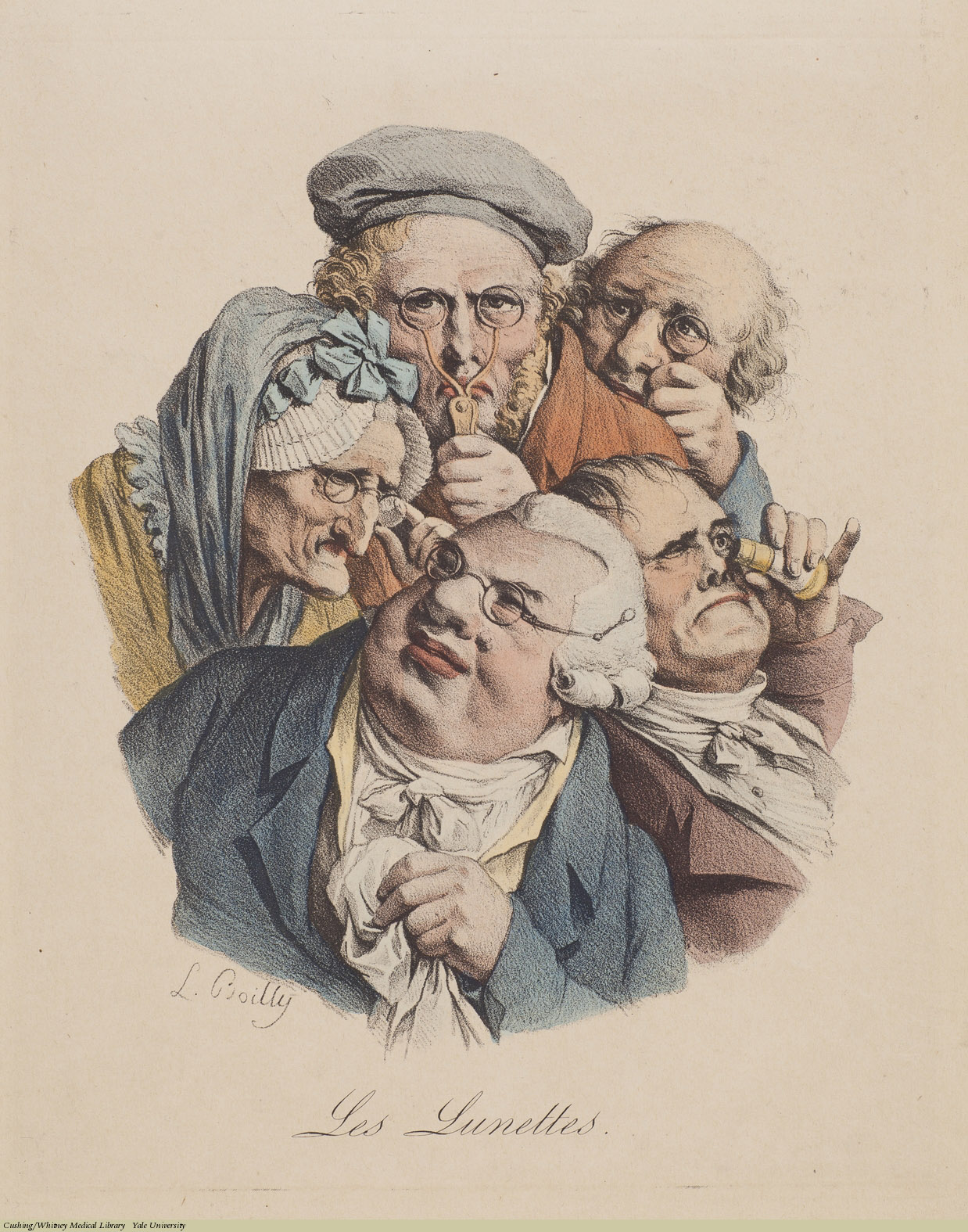
Louis-Léopold Boilly, Les Lunettes (Eyeglasses), Lithograph, undated.
I’ve had thorns in my head for well over a week, and finally got started on drawing yesterday, still not done on that front, but I had to play with colour a bit today. I’ve been working late, then falling into bed, not scheduling anything on Affinity, so if I’m late, or space out regular features, blame the thorns in my head. This one is going to take a long time, too. It’s large, filled with detail, and I’m going with pencil instead of paint, which is always slower for me. It’s been so long since I’ve been able to work, I’m now consumed with the need. Bad photo:

© C. Ford, all rights reserved.
Still with Louis-Léopold Boilly. Click for full size!

Les Sangsues, Louis-Léopold Boilly, Lithograph,1827.
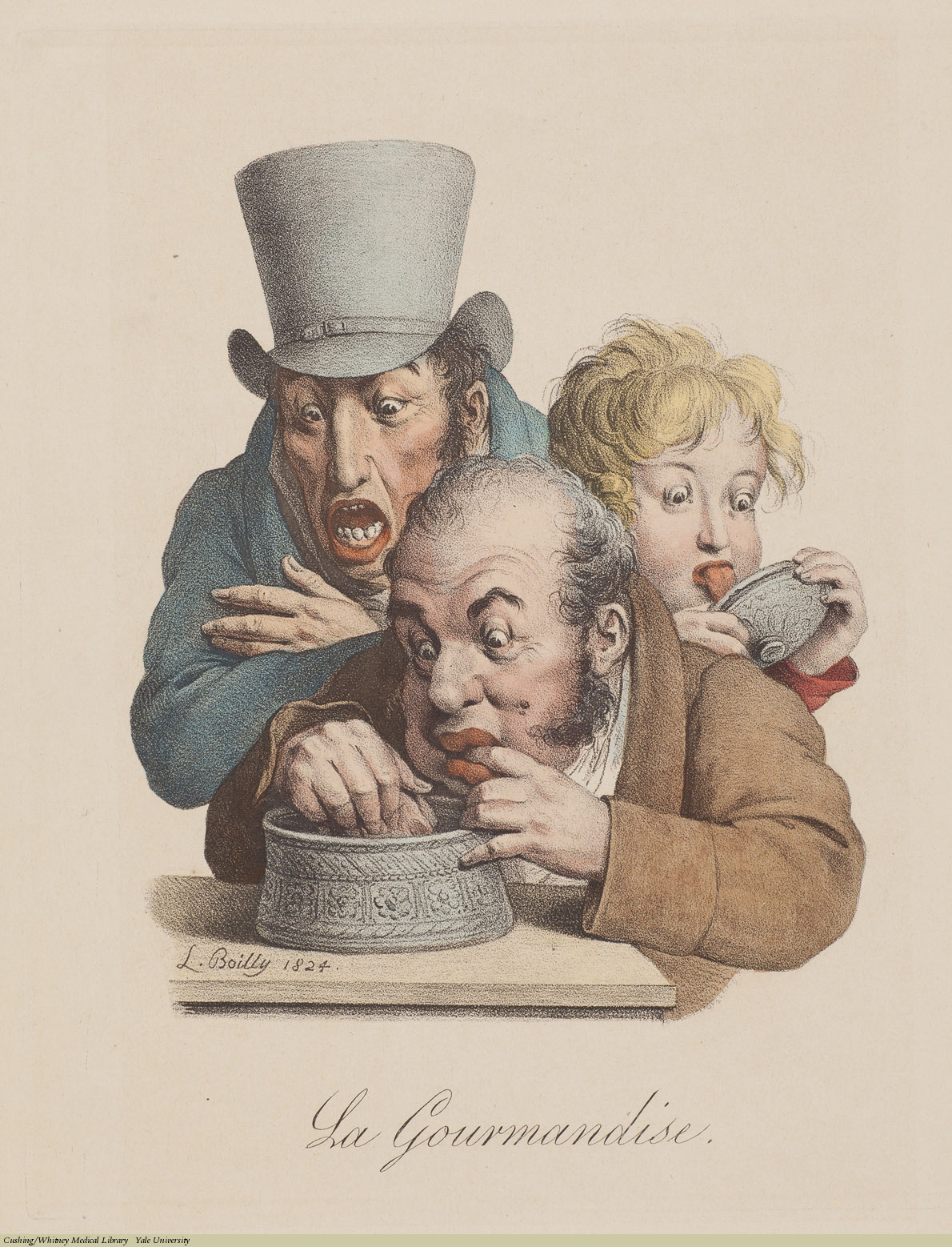
La Gourmandise, Louis-Léopold Boilly, Lithograph,1824.
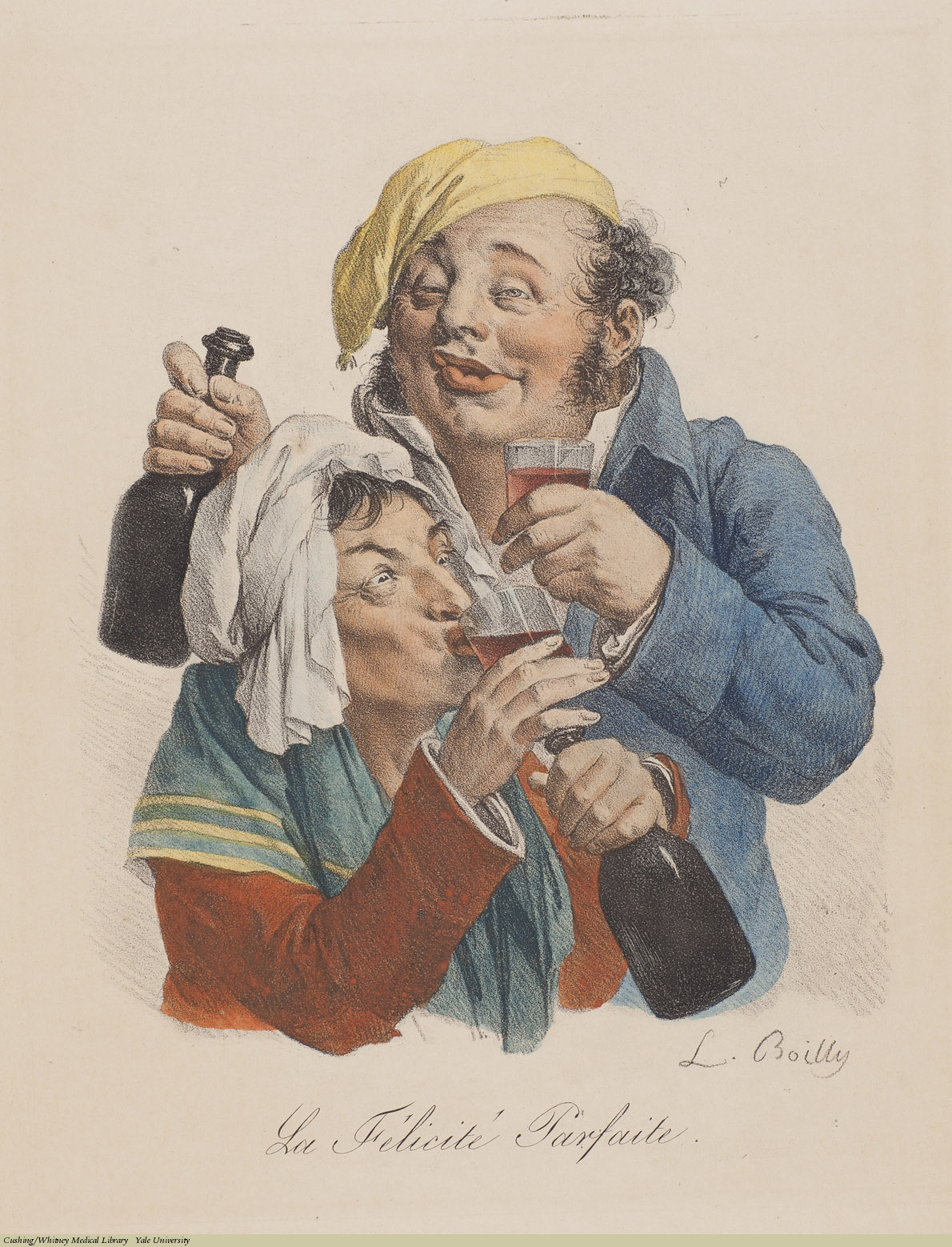
La Felicité Parfaite, Louis-Léopold Boilly, Lithograph.

Les Ivrognes, Louis-Léopold Boilly, Lithograph, 1828.
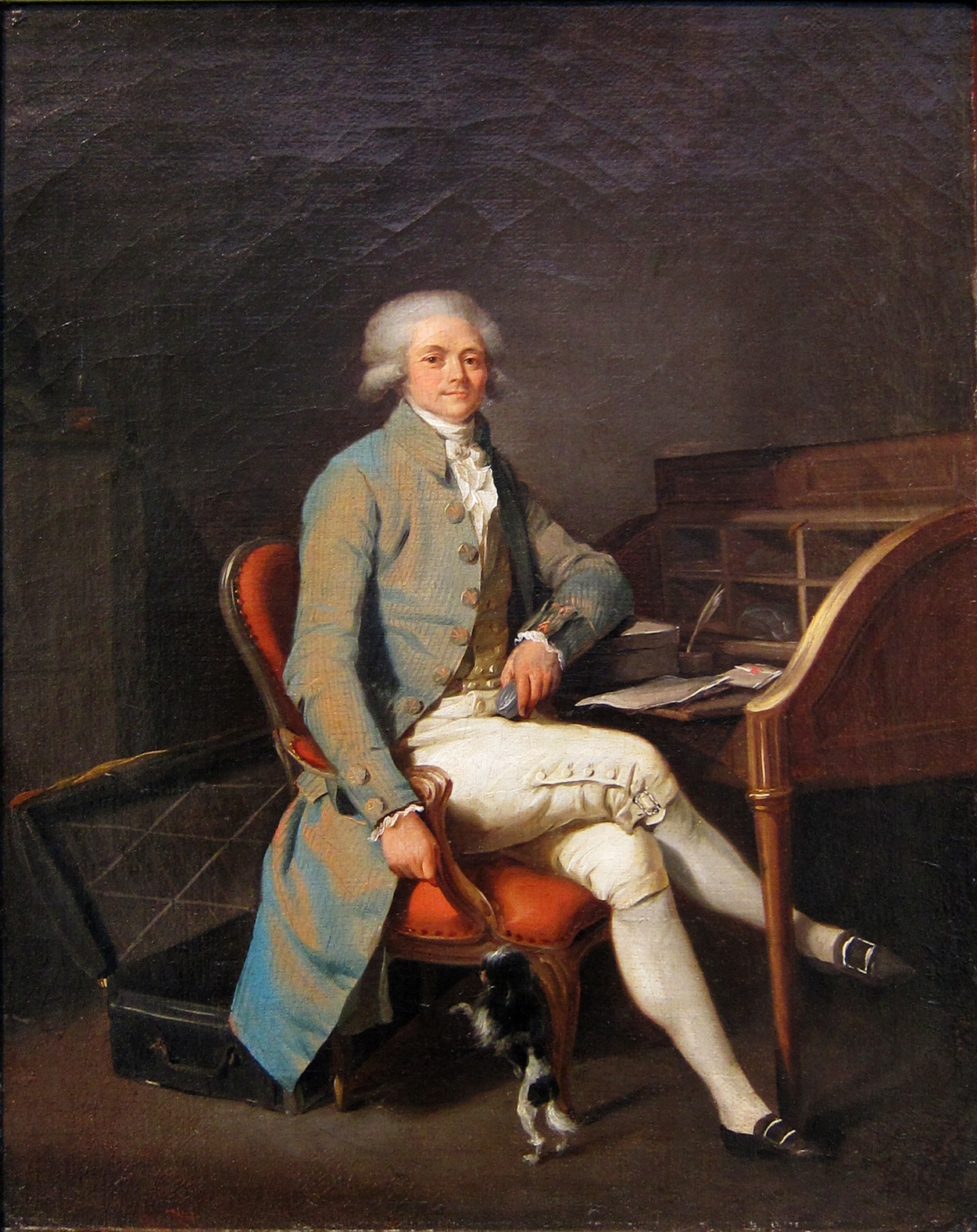
I’ll be indulging in a highlight of Louis-Léopold Boilly the next day or three. Boilly was an incredibly talented artist, with an extraordinary gift for portraiture. Looking at his paintings, you get a strong sense that you should not be staring in the window, looking at these people, because there is a profound intimacy in his paintings. The Geography Lesson (Portrait of Monsieur Gaudry and His Daughter) is a good example of this intimacy. I also think his portrait of Robespierre is the absolute best. Boilly was a prolific painter, producing a great many small portraits as well as full scale paintings. When it comes to Les Grimaces, I like Les Grimaces 3 best. I think. All images, click for full size!

Consultation de Medecins. 1760, Lithograph, Louis-Léopold Boilly.

Les Grimaces 1, Louis-Léopold Boilly, 1823.

Les Grimaces 3, Louis-Léopold Boilly, Lithograph, 1823.

Les Grimaces 8, Louis-Léopold Boilly, Lithograph, 1823.
A new series! The Harvey Cushing/John Hay Whitney Medical Library has an absolutely astonishing collection of old prints and drawings, all to do with medical matters. There are exquisite anatomical drawings, drawings of hospitals, and the like, but I won’t be posting those. There are wonderfully satirical prints, interesting characters, and depictions of certain maladies, etc., of which, many tickle my fancy. We’ll start with Mary Tofts, who drew a great deal of attention, from on high to low in her day, for giving birth to rabbits. (All images, click for full size.)

Mary Tofts of Godelman the pretended Rabbit Breeder, mezzotint, John Laguerre, c. 1726.
Moving on to…head stones! :D
![Loopt loopt met groot... [Operation for Stones in the Head], Laid, Claes (Nicolas) Jansz Weydtmans.](https://i2.wp.com/freethoughtblogs.com/affinity/files/2018/05/HeadStones.jpg?ssl=1)
Loopt loopt met groot… [Operation for Stones in the Head], Laid, Claes (Nicolas) Jansz Weydtmans.
Finally, we have a scary look at Elephantiasis, [Warning: A very graphic photo at that link.] a most dread disease back in the day. Note that the woman depicted has 6 toes on each foot.
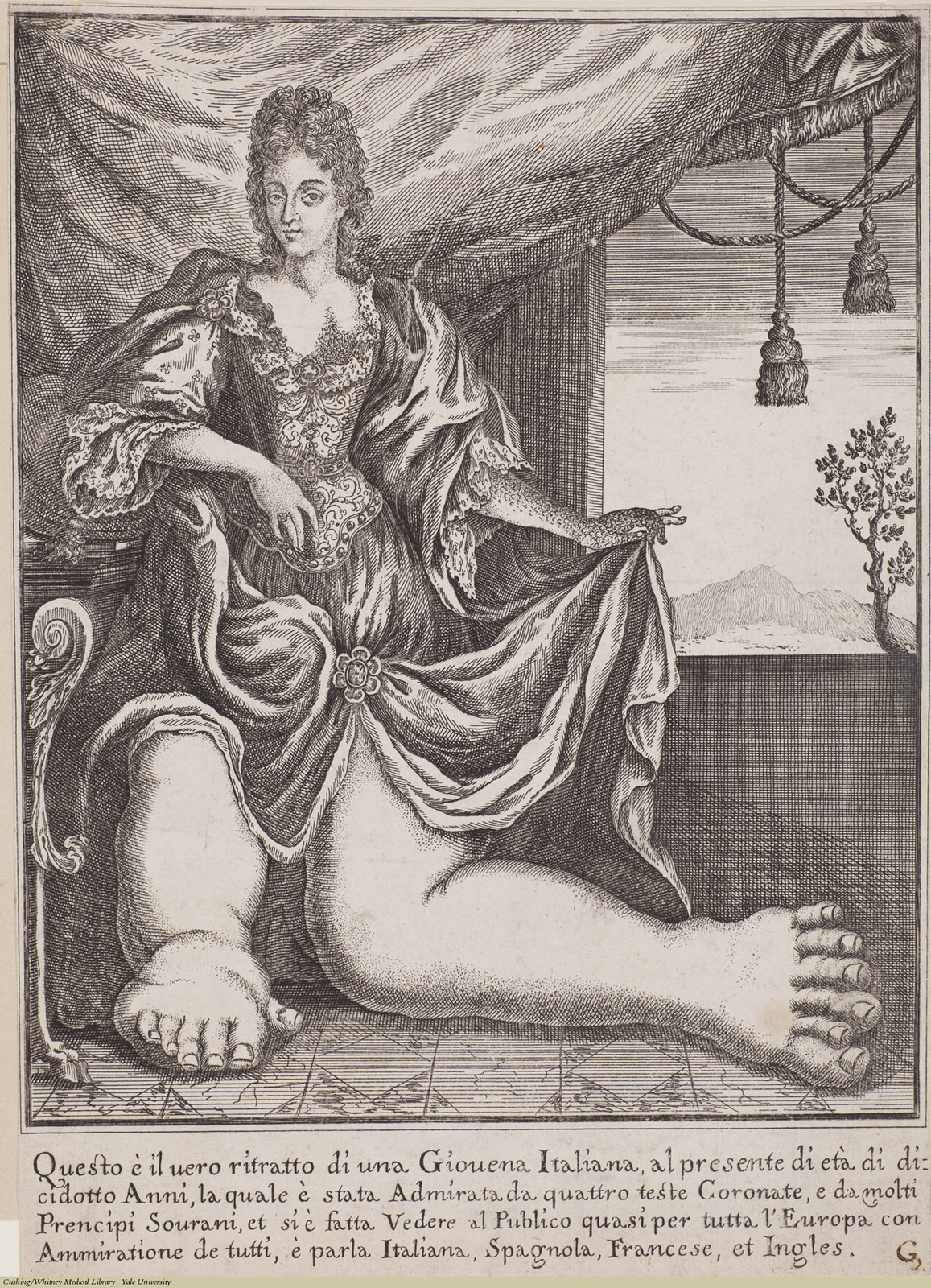
Woman with Elephantiasis, Laid, Anonymous, Italian, 18th Century.
The long pause was no pause at all. I worked on the blade every evening and but I could not give it more than half an hour to one hour a day, so the progress at this stage was very, very slow.
After the hardening came tempering, which is rather easy and dull process. I wanted the blade to be primarily tough, not overtly hard, so I gave it two half hour courses at 200 °C in the baking oven. This has removed a lot of the hardness and almost all of the brittleness. It should be easy to sharpen and maintain sharp but it should not snap when hitting something hard. With a kitchen knife I would lower the temperature to 150 °C or perhaps perform differential tempering.
 Next step is polishing. This is by far the most time-consuming and dull part of making a knife. Here are all the belts on my belt hanger. Before hardening I went all the way from left where the pink ceramics belts are (P40-P120) through middle blue-green zircon-corund (P120-P320). After hardening I gave it one more pass with zircon-corund P320. Very thorough pass, because the blade was slightly pitted from the failed hardening attempts. After that came the last third of the belts, which are Trizact belts (A65-A6, which is equivalent of P300 to P2500). There are six Trizact belts, and each took approximately one hour. Had I more experience I could perhaps speed it up by 30-40%, but it would still be a lot of time – I want the blade to be as near perfect as I am able to make it. So at each stage it is important to remove absolutely all scratches made by previous belt.
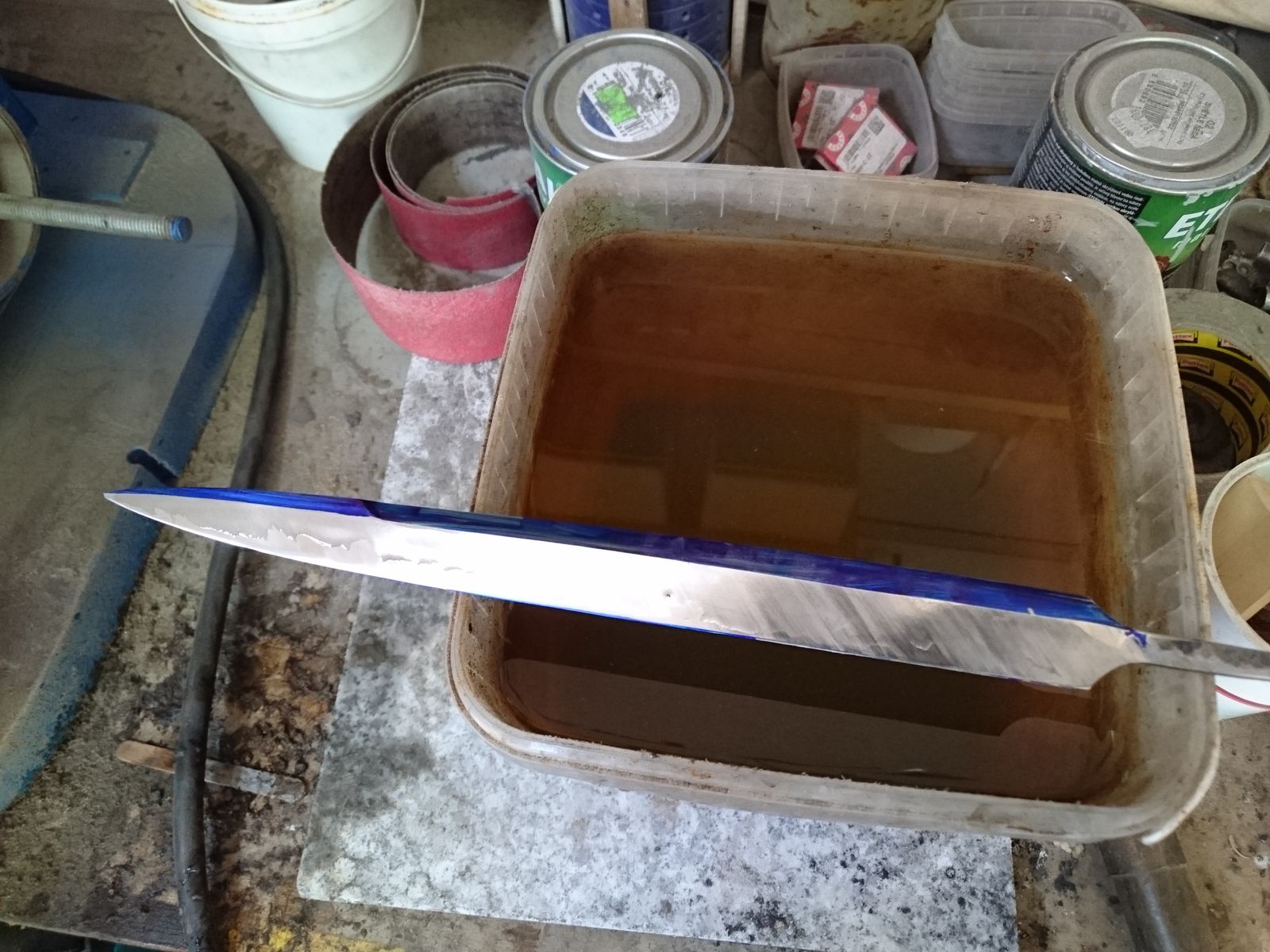 Of course thick blue marker helps here as well, because otherwise I could get easily confused about which facet I am working on. As I learned when doing my previous dagger. To be able to see the marks from previous grind, one does alternate the angle – that is for this facet for example I was grinding diagonally with the point down, so next step will be with point up. Were the facets perfectly straight and not wobbly at all from the beginning, the process would be fast. Alas they were wobbly and I made them wobbly in the process in decreasing degree of wobbliness untill I reached nearly straight towards the end. What I learned here is that I really, really need speed control for my belt grinder, because during polishing slower speed of the belt would speed up the work – I would get better control of the blade and most importantly, the edges of the belt would not make divets and scratches so fast as they do. However even as it is it is working well, but requires a lot of skill that I do not yet have. A lot of eyeballing was involved.
 Today I finished on the grinder but I am still not done. For a mirror-finish more work is needed. Kitchen knife would get a few passes on a buffing wheel at this point and that would be it. That would give it nice mirror finish but the scratches from the trizact belts would still be somewhat visible. For this one though now comes excessive use of elbow grease. I will work my way through a series of wet polishing papers P2500 all the way to P7000. For this I use my trusted gizmo that has seen me through multiple blades already. A piece of hardwood board held in a vice, with leather strap glued on it. On the leather I can lay a strip of sandpaper. Sometimes I rely on the adhesion between the wet leather and the sandpaper to hold it in place, sometimes I hold the paper in place with the help of two springs and something made from fence wire I cannot put a name to.
After that I will be done with this phase and I will be able to perform the last step in making a blade – signing it.
I still have not resolved how to do that. I used to have my own maker’s mark consisting of my stylized initials. It was very easy to etch or engrave and I would love to continue to use it. But by purest of coincidences that very same mark was a few years later independently designed as Bluetooth logo. We’ll see what I come up with.

Stephen Wright in the front room of the House of Dreams. Vice.

Feelings. This text in this picture describes how I feel about the House of Dreams, my work, and my artistic life journey. I sometimes don’t have a clue what I am doing and why. I only know it’s the right thing for me to do.
Take some time today to meet an extraordinary artist, Stephen Wright. His House of Dreams is amazing, to say the very least, and the story of his journey is both wondrous and terribly poignant. Vice has an in depth interview with Mr. Wright, and you can take a virtual tour of the House of Dreams, or book an actual visit.
I have a deep and abiding love of Medieval Manuscripts, there’s always more to discover and wonder over, and here’s a new and delightful discovery to me, the early repairs of manuscripts, where beautiful embroidery was utilised to repair flaws in the parchment.

A plain-colored stitch incorporated into a drawing. Gerald Raab/ Courtesy Staatsbibliothek Bamberg.
In the Cantonal and University Library in the ancient city of Fribourg, Switzerland, is a 14th-century manuscript with some gloriously beautiful defects. Scattered throughout the text are small tears and holes. And many of them have been carefully, intricately stitched together with colorful thread.
[…]
Holes in the parchment weren’t always dealt with, but when they were, any repairs needed to be done before it could be written on. This might include both patching over holes and evening out edges, explains Sciacca. The repair method could be crude or rudimentary—“Frankenstein” repairs, as Sciacca jokingly calls them—but, as writer Paul Cooper recently highlighted, sometimes they could be quite beautiful.
In that same 14th-century text in Fribourg, a single page is elegantly adorned with two sets of thin stitches, one pink, one green. Elsewhere in the same manuscript there are rainbow-hued repairs of different shapes and sizes. In a text held at the Engelberg Abbey library in Switzerland, stitches at the edge of the page create a “rope”, as Sciacca refers to it, to fill in the edge of the parchment. And from the same library, the missing side of one page has been patched with an additional square of parchment.

A series of repairs made in James of Voragine’s 14th-century Golden Legend. Courtesy Cantonal and University Library Fribourg, Switzerland, Ms. L 34.
As medieval book historian Erik Kwakkel points out, these repairs must have been common in certain monasteries. “Where I was finding a lot of these embellishments were in manuscripts that came from either nunneries, or from what they call in Germany, double cloisters,” Sciacca says. “So you have this paired male and female monastic community. They live separately, but they’re allied with each other, and they’re physically located next to each other. So it seems that this may be part of what was, in fact, women’s training, what was nuns’ training, which was to practice embroidery. And they were doing it not just on textiles, but also actually in manuscripts.”
Stitching wasn’t the only way to make the best of flawed parchment. There are instances of holes being incorporated into illustrations, or used to reveal an illustration on the following page. The stitches themselves could even be embellished. In a text in Germany’s Bamberg State Library, a curve of plain-colored stitching is surrounded with the drawing of a man so that the thread resembles his skeleton.
You can read much more, with lots of links, and see much more at Atlas Obscura. Fascinating!