A Collared-Dove gives me the eyeball from on high, click for full size.


© C. Ford.

A Collared-Dove gives me the eyeball from on high, click for full size.
© C. Ford.
As with all things Tiny Tyrant, incompetency and stupidity rule. Politico has the story on how the so-called commission on voter fraud is open to yet more hacking, and would provide a goldmine for those with cybercrime on their mind.
Cybersecurity specialists are warning that President Donald Trump’s voter-fraud commission may unintentionally expose voter data to even more hacking and digital manipulation.
Their concerns stem from a letter the commission sent to every state this week, asking for full voter rolls and vowing to make the information “available to the public.” The requested information includes full names, addresses, birth dates, political party and, most notably, the last four digits of Social Security numbers. The commission is also seeking data such as voter history, felony convictions and military service records.
Digital security experts say the commission’s request would centralize and lay bare a valuable cache of information that cyber criminals could use for identity theft scams — or that foreign spies could leverage for disinformation schemes.
“It is beyond stupid,” said Nicholas Weaver, a computer science professor at the University of California at Berkeley.
“The bigger the purse, the more effort folks would spend to get at it,” said Joe Hall, chief technologist at the Center for Democracy and Technology, a digital advocacy group. “And in this case, this is such a high-profile and not-so-competent tech operation that we’re likely to see the hacktivists and pranksters take shots at it.”
Indeed, by Friday night, over 20 states — from California to Mississippi to Virginia — had indicated they would not comply with the request, with several citing privacy laws and expressing unease about aggregating voter data.
[…]
Experts also criticized the commission’s two options for states to submit their data: via a White House email address and a Pentagon-run file-hosting service.
“Email is the worst; it’s like sending all your postal mail using postcards instead of letters in envelope,” Hall said. “It’s one of the harder methods of communication to secure.”
The commission’s alternative option, a file-hosting service run by a branch of the Army, isn’t currently configured to properly encrypt web traffic, which Hall said was “a massive red flag for their ability to properly secure other forms of secure file transfer.”
The perceived digital security miscues left many specialists stunned.
“Nothing about this letter appears to take information security into account,” said Matthew Green, a computer science professor and cryptography expert at Johns Hopkins University. “If I didn’t know this letter was real, I would assume it was a clever spearphishing campaign.”
When it comes to my state, I’m afraid to look, but I’m sure they are being compliant. Yet another thing to worry about. Politico has the full story.

Installation view, Brian Belott’s Dr. Kid President Jr. at Gavin Brown’s Enterprise. (Images courtesy the artist and Gavin Brown’s Enterprise.)
…She went around the globe collecting kids’ art, so a lot of the art in this show is international. We have art here from Switzerland, from India, from Egypt, from Tibet. What she found was that no matter where finger painting went on across the globe, kids were essentially drawing the same stuff. In Hero with a Thousand Faces, Joseph Campbell compared creation myths, showing the common thread through seemingly disparate cultures. Rhoda was finding the same thing, but in children’s scribbles. She was going into this nexus of gobbledygook and nonsense, with very little support, and she winds up finding that within scribbles are repeating shapes, like the mandala or the Greek cross. What she’s also seeing bubbling up from this is the beginning of all language – the alphabet.
NR:But it’s a graphic language, as opposed to an alphabetic one, so it exists apart from a specific language or nation?
BB: Absolutely. There are certain things the body loves to do, like making a cross, or an X, or a loop-de-loop. These actions are born in the time of early childhood. What’s wild, too, about this practice is that, for the kids, it’s akin to running around on the playground, because kids are only half of the time thinking deeply about what they’re doing. It’s more about motor action and covering a surface.
That’s part of an interview with artist Brian Belott about his latest exhibition, which focuses on the art of children. I was quite struck by the last sentence in the quote above: “It’s more about motor action and covering a surface.” That’s exactly what I’m doing with the Tree Quilt. My fingers go to work, while my mind wanders afar. I surface now and then, to see what my fingers have been doing, then wander off again. I’ve noticed during the time I’ve worked on the tree quilt, that anytime I’m actually focused on it, and thinking about it, I just can’t get anything to work, at all. I end up having to tuck it away. When I’m not paying attention, but my body is singing with energy, and there are a million other things to occupy my mind, the shapes and colours which form are strange, happily organic, and very pleasing to me. Maybe that’s why I’m stretching out the work time on it so much – not just that I have to walk away when I’m in ‘adult’ mode, but at its core, it’s a childish scribble, one which makes me quite happy.
The full interview is at Hyperallergic.

Politico has an excellent story up about the Colorado Springs experiment. The town elected a real-estate maven, with no political experience at all, who promised to make Colorado Springs great, just run it like a business. Sound familiar? In most respects, Steve Bach is just like a certain Tiny Tyrant. Bach also made much hay out of the whole “jobs, jobs, jobs!” business, which did not pan out in the slightest. This is a good lesson, because this is the road the whole damn country is going down, and it is going to fail, spectacularly. People rarely want to employ sense when it comes to money, and this is particularly true of Americans, who are always looking for a whole lot of something for nothing.
For a city, like the country at large, that was hurting economically, Steve Bach seemed like a man with an answer. What he promised sounded radically simple: Wasteful government is the root of the pain, and if you just run government like the best businesses, the pain will go away. Easy. Because he had never held office and because he actually had been a successful entrepreneur, people were inclined to believe he really could reinvent the way a city was governed.
The city’s experiment was fascinating because it offered a chance to observe some of the most extreme conservative principles in action in a real-world laboratory. Producers from “60 Minutes” flew out to talk with the town’s leaders. The New York Times found a woman in a dark trailer park pawning her flat screen TV to buy a shotgun for protection. “This American Life” did a segment portraying Springs citizens as the ultimate anti-tax zealots, willing to pay $125 in a new “Adopt a Streetlight” program to illuminate their own neighborhoods, but not willing to spend the same to do so for the entire city. “I’ll take care of mine” was the gist of what one council member heard from a resident when she confronted him with this fact.
That’s where Colorado Springs was frozen in the consciousness of the country—a city determined to redefine the role of government, led by a sharp-elbowed businessman who didn’t care whom he offended along the way (not unlike a certain president). But it has been five years since “This American Life” packed up its mics. A lot has changed in that time, not least of which is that the local economy, which nearly drowned the city like a concrete block tied around its balance sheet, is buoyant once again. Sales tax revenue has made the books plump with surplus. Enough to turn those famous streetlights back on. Seven years after the experiment began, the verdict is in—and it’s not at all what its architects planned.
One of the lessons: There’s a real cost to saving money.
Take the streetlights. Turning them off had saved the city about $1.25 million. What had not made the national news stories was what had happened while those lights were off. Copper thieves, emboldened by the opportunity to work without fear of electrocution, had worked overtime scavenging wire. Some, the City Council learned, had even dressed up as utility workers and pried open the boxes at the base of streetlights in broad daylight. Keeping the lights off might have saved some money in the short term, but the cost to fix what had been stolen ran to some $5 million.
[…]
There has been a lot of this kind of reckoning over the past half-decade. From crisis came a desire for disruption. From disruption came, well, too much disruption. And from that came a full-circle return to professional politicians. Including one—a beloved mayor and respected bureaucrat who was short-listed to replace James Comey as FBI director—who is so persuasive he has gotten Colorado Springs residents to do something the outside world assumed they were not capable of: Five years after its moment in the spotlight, revenue is so high that the same voters who refused to keep the lights on have overwhelmingly approved ballot measures allowing the city to not only keep some of its extra tax money, but impose new taxes as well.
In the process, many residents of Colorado Springs, but especially the men and women most committed to making the city thrive, have learned a few other lessons. That perpetual chaos can be exhausting. That the value of the status quo rises with the budget’s bottom line. And that it helps when the people responsible for running the city are actually talking with one another. All it took was a few years running an experiment that everyone involved seems happy is over.
These were for the rats, not me, but they were eaten with enthusiasm. Click for full size.

© C. Ford.
From Lofty, a Pelican. I’m gobsmacked. Click for full size!


© Lofty, all rights reserved.
The Postal Museum Opening July 2017 from The Postal Museum on Vimeo.
During the First World War, in order protect art treasures from German attack, English museum administrators worked with the country’s national postal service to store precious artworks in a network of subway tunnels 70′ below street level. Now, you can take a ride through the historic Mail Rail when you buy tickets to London’s Postal Museum opening July 28th.
Roughly 100 years ago, the Post Office in London started utilizing a secret labyrinth of narrow tunnels, 6.5 miles long, to safely transport letters, parcels, and postcards through the city. At its peak, the Mail Rail system operated 22 hours a day and employed 220 staff that moved more than four million letters daily. The network of tunnels criss-crossed tube lines and linked six sorting offices with mainline stations at Liverpool Street and Paddington. The underground Mail Rail operation was so covert that museums like the Tate, British Museum and National Portrait Gallery deemed it safe enough to store their most precious artworks. According to representatives for the Postal Museum, the British Museum once even used the tunnels to store the Rosetta Stone.
There’s more at The Creators Project and The Postal Museum.

The Virgin Artiste.
At The Bushwick Collective block party early in June, Ashleigh Alexandria, who goes by The Virgin Artiste, body painted a model live against a brick wall covered with a graffiti painting of a skull, the work of eight-year-old street artist Ethan Armen. As Ashleigh was photographing her work on top of Armen’s work, a cop walked by. “I found the imagery of a nude, Black model covered in paint close to a police officer to be ironic,” Alexandria tells Creators, “due to the recent police killings of Black men and women.”
Sometimes Alexandria’s subjects are painted to blend into their backgrounds, but more often than not, her subjects stand out from their environment while still remaining a part of it. A lifelong New Yorker, Alexandria is a portrait artist and a body painter whose work plays with the practice of body paint blending made famous by artists like Liu Bolin, in which subjects are made to disappear into their surroundings. While Bolin is an important influence, Alexandria’s practice is a reinterpretation of this concept. “My use of women of color as subjects shows how these women can be blended into the background of American society,” she explains.
You can see and read much more at The Creators Project.
Ghastly, ghostly, and gory, Neill Blomkamp’s new sci-fi short Firebase is set in a Vietnam War haunted by more than just post-traumatic stress disorder and political unrest. While the latter are resolutely present, soldiers on the front lines face a supernatural force so powerful and destructive they refer to it as “The Devil.” Obviously the CIA is involved, which is why the details of this faux documentary aren’t in our modern day history books.
“Volume 1” of the District 9 and Chappy director’s latest introduces us to the second cinematic universe by Oats Studio, his new independent venture invoking the power of fandom with a “pay-if-you-can” business model. The first in the series is Rakka, an allegory for military occupation in which a human resistance led by Sigourney Weaver fights a brutal alien race equipped with powerful weapons and mind control. Firebase turns inward, examining the destructive force of trauma through the lens of American troops invading Vietnam. Warning, this film is bloody.
If you want to find out what happens next, you can support Oats Studio by purchasing the film on Steam.
You can read more about this at The Creators Project.
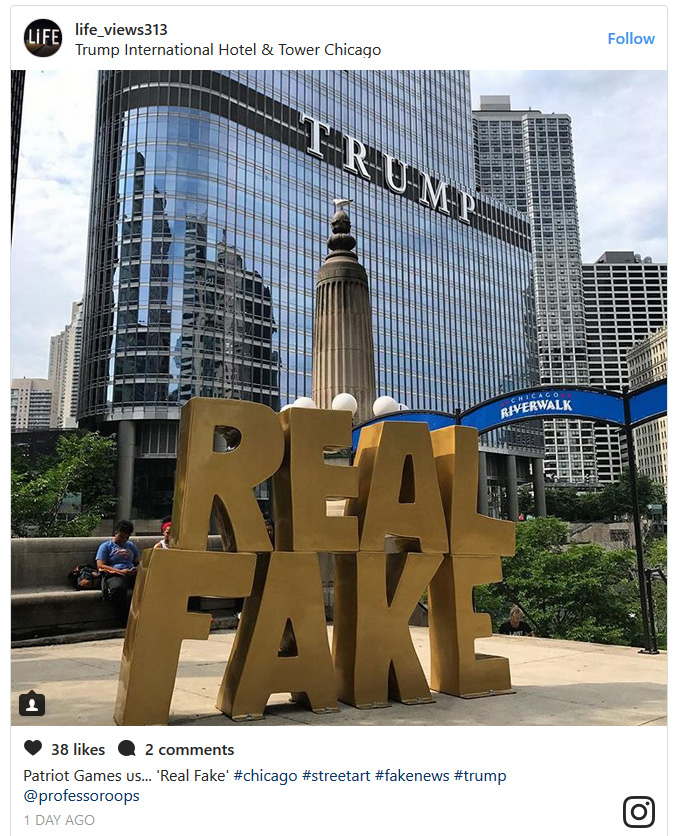
Is the City of Chicago trolling the 45th president of the United States? A gleaming, six-foot-tall sculpture that appeared this week near the downtown Trump International Hotel and Tower certainly suggests so, spelling out just two words in thick, golden letters: “REAL FAKE.”
The quip appeared on Monday evening, installed by the Chicago Department of Cultural Affairs and Special Events (DCASE) as part of a new installation of public art along the Chicago Riverwalk. Simply titled “Real Fake,” the 350-pound fiberglass work, coated in metallic paint, appears as a direct dig at President Trump and his endless dismissal of the media’s criticisms as “fake news” while leading a life of fraudulence himself. But the piece, created by local artist Scott Reeder, was actually first installed in 2013 as part of Art Basel Miami Beach, where it loomed on the grassy knoll of Collins Park. It’s on loan to the city now by Reeder’s gallery, Kavi Gupta.
Hyperallergic has the full story on Real Fake!

John Pfahl, “Bethlehem #25) (1988), color print. (courtesy Cantor Arts Center).
A fascinating look at the landscape photographers of the 1960s and 1970s, the refusal to romanticize the landscape, and the intertwining of art and environmentalists. Full story here.
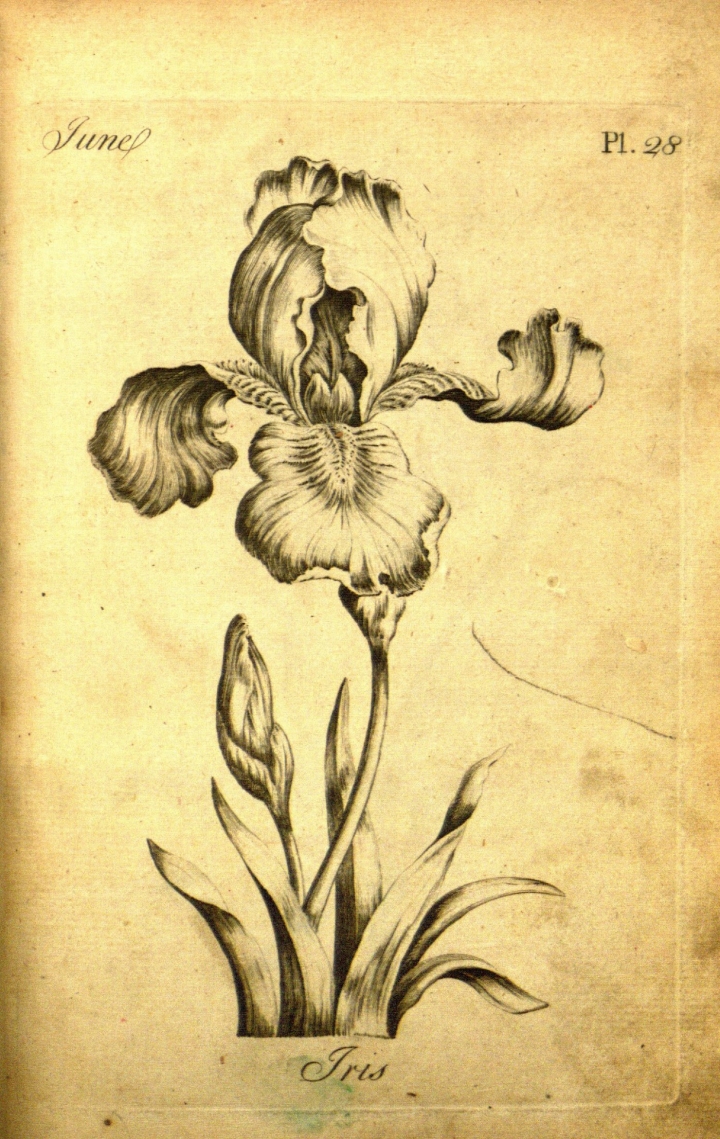
Sketch of an iris from The Florist (1760).
The Florist, printed in 1760, was a colouring book for adults, and one for serious colourists with watercolour experience.
The Florist was intended, as its title page relays, “for the use and amusement of Gentlemen and Ladies.” But, unlike most contemporary coloring books, it wasn’t meant to soothe the mind or encourage limitless creativity; rather, it served more as a manual for those seeking to sharpen their artistic skills. The Florist was for serious adult colorists only, filled with detailed instructions on how to paint each flower strictly according to its natural colors. (Yes, paint — this was the pre-crayon and -colored pencil era, so aspiring artists would have used watercolors.) See the directions, for instance, for a gladiolus:
This flower is crimson, inclining to purple; begun with a string layer of carmine, and neatly shading with a mixture of carmine and prussian blue. The bottom of the flower is white, shaded with a greenish tinge, by a mixture of Indian ink and sap-green; neatly blending the carmine by it, by fine strokes of each color. The leaves and stalk, from the beginning of the flowers of the top, are a brown, made with sap-green and carmine.
You can read all about The Florist, and see more, at Hyperallergic.
From Charly: Another capture during my picture hunt. A parasitic wasp from the family Sphecidae. She was frantically running and flying around in complicated curves and it took me awhile until I realized what she is doing – she was digging her nest and memorizing its surroundings so she can find it. I got lucky a few times to get her somewhat into focus before she buzzed off probably to eat something to get strength for further digging. Rare shots, click for full size!
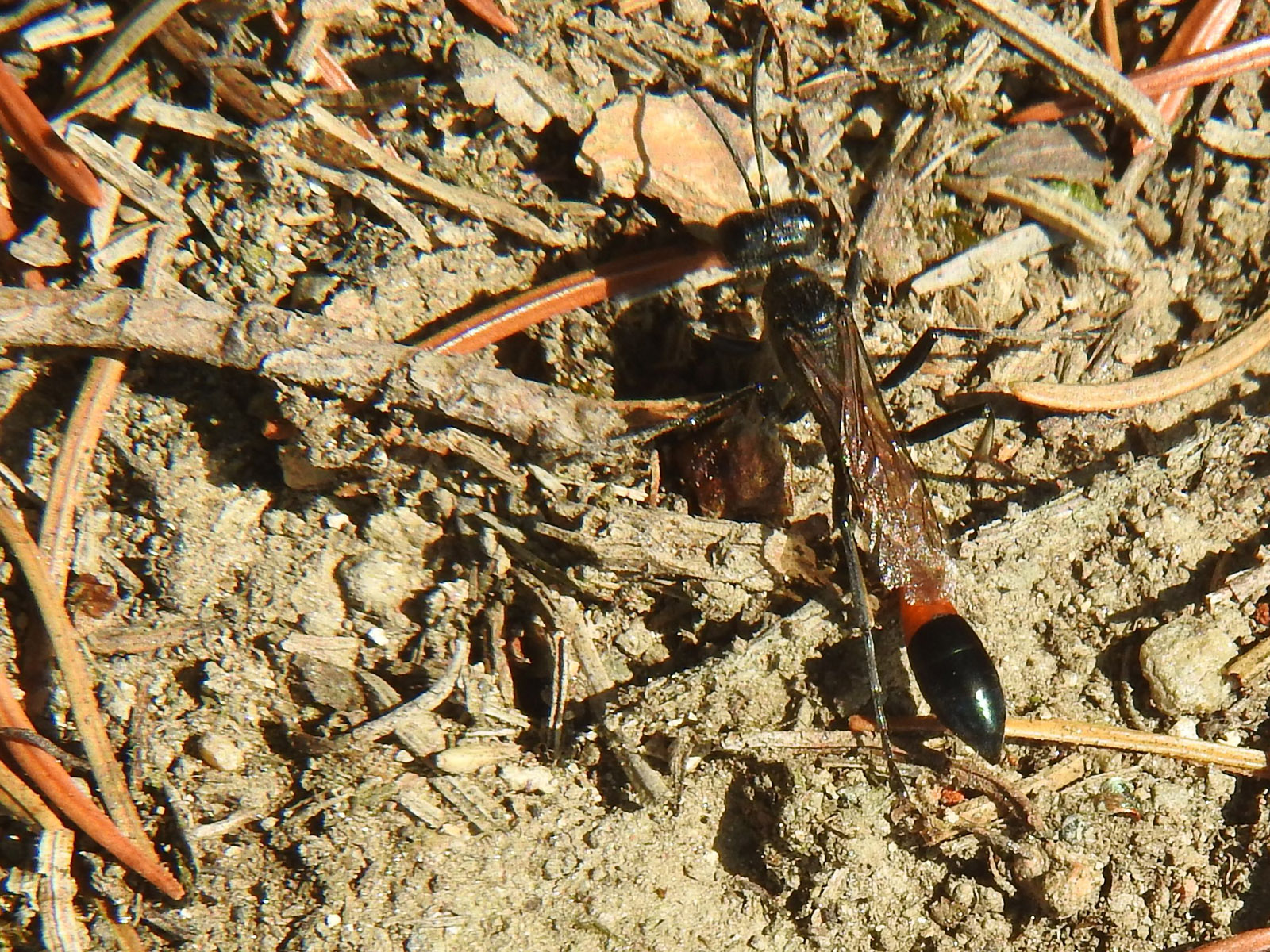

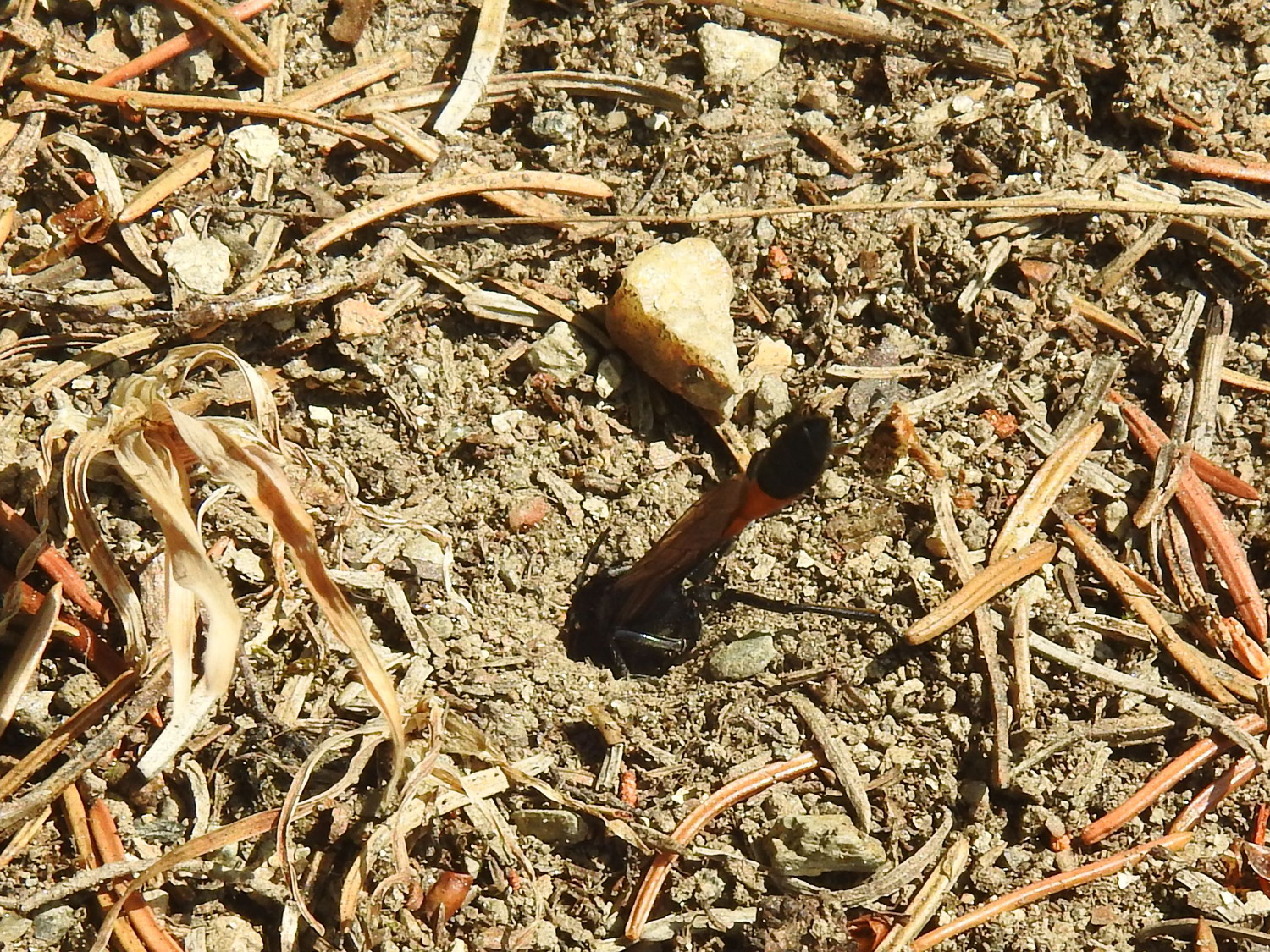
© Charly, all rights reserved.
Who says you can’t play with your food? Click for full size. (Yes, I ate the bread. Delicious!)
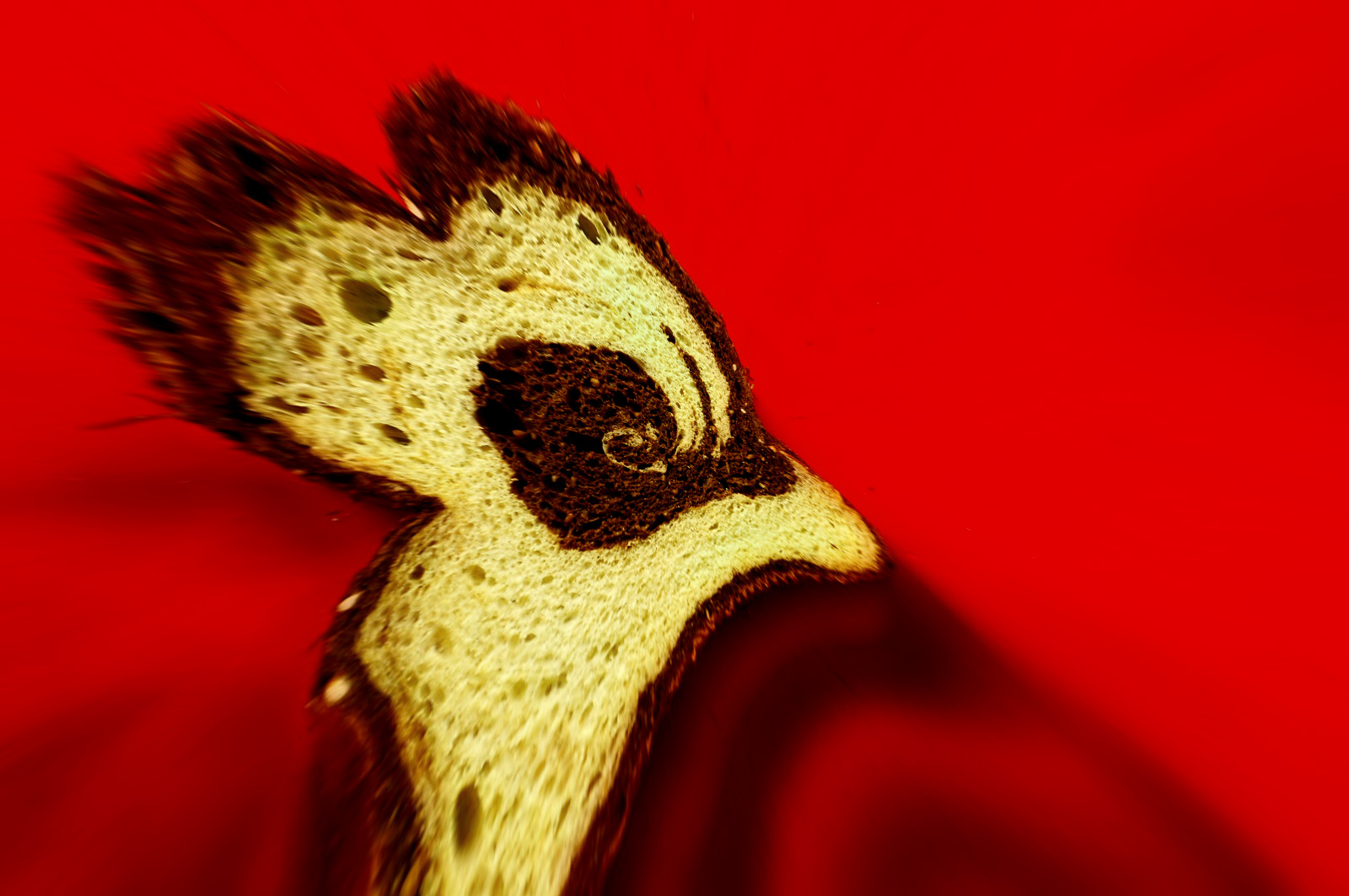


© C. Ford, all rights reserved.
Some wonderfully dramatic wing drying from David, click for full size!


© David, all rights reserved.