
In an earlier posting about my osoraku dagger, I made a comment to the effect that rocks are pretty yawn-riffic. “Ha ha ha,” laughed the fates and fired up their favorite app: “Comeuppance”
In [stderr] Senior Aggregate Executive badland rebutted my point thus (edited for brevity):
feral hissing
It was not long after my sloppy comment that I noticed that my softish binsui (medium coarse) stone sure was wearing fast, and if I kept wearing the little bastards down, then buying more from Japan, I might eventually get on a certain radar screen and there would be protective tariffs for Arkansas stones, etc. Ever since I scrambled it, this is how my brain works: A is interesting, B is interesting, and that means we need to research the hell out of G. Naturally I wondered if there is anything special about Arkansas stones (I assume they’re inbred and wear red hats?)* Uh, oh, it turns out that rocks are actually interesting. For one thing, there would be fewer castles like Kerak Des Chevaliers without rocks, and the Egyptian pyramids would be much less notorious if they had been mounds of sand.
It almost certainly wouldn’t occur to anyone that shipping off a tariff-boosted $300 to Japan for rocks wouldn’t make me wonder why binsui stones were expensive, anyway. A decent-sized tanto blade would consume most of one. I often share old-time production videos with my dad (we can’t get enough of it!) including a spectacular series on how millstones are made in the 60s.
There are videos (converted from 6mm film) of little me, helping bring in the wheat harvest with oxen, from southern France, around the same time. The characters in that movie are instantly recognizable to me – I even know what they smell like, though dad and I are pretty sure they’re northerners, but literally everything about them is familiar, including the waist bands (can’t afford to fix a hernia and every working man has one), the caps, etc. Anyhow, the curiousity built up to the point where I asked GPT “do you have any strata assays for Clearfield county that indicate locations where good sharpening stones might be found?” I don’t know if you noticed but hauling something like that millstone is not a Fun Task. It stands to reason that our planet is made of a lot of sandstone and whatnot, it’s just a question of where.
[By the way, I am very very familiar with the “Rock Pun” sedimentary threads, and let me please request the comment sections not be completely formed of rock puns. I mean, do what you gotta do, but go for quality not quantity in honor of this topic] Anyhow, GPT gave me a couple of interesting pages of stuff about local strata of novaculite, and oil shale, which would be pretty good and I opined that the strip mine 2 miles from my shop might be a fun drive-by. What is the worst thing that could happen?
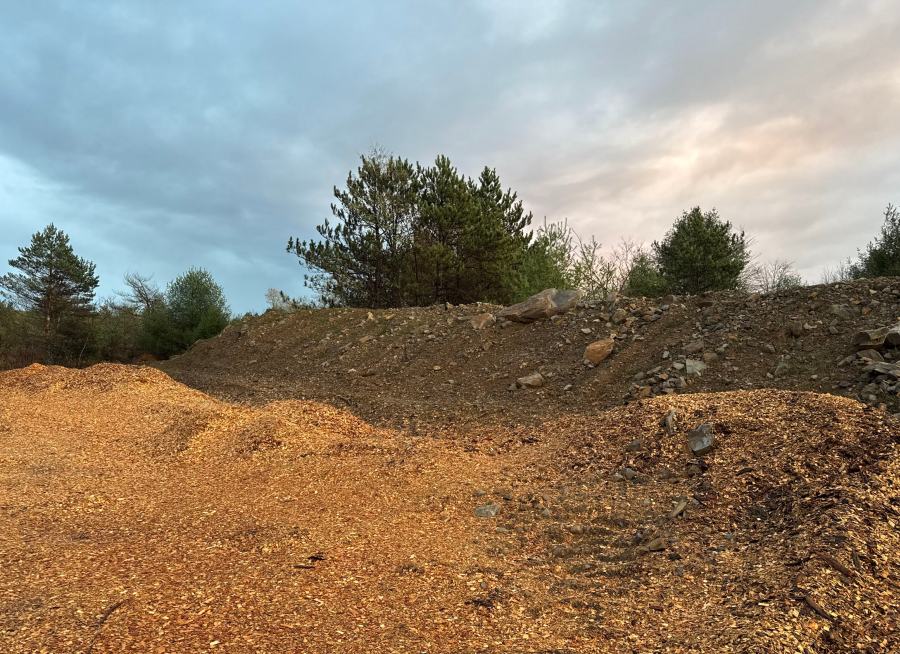
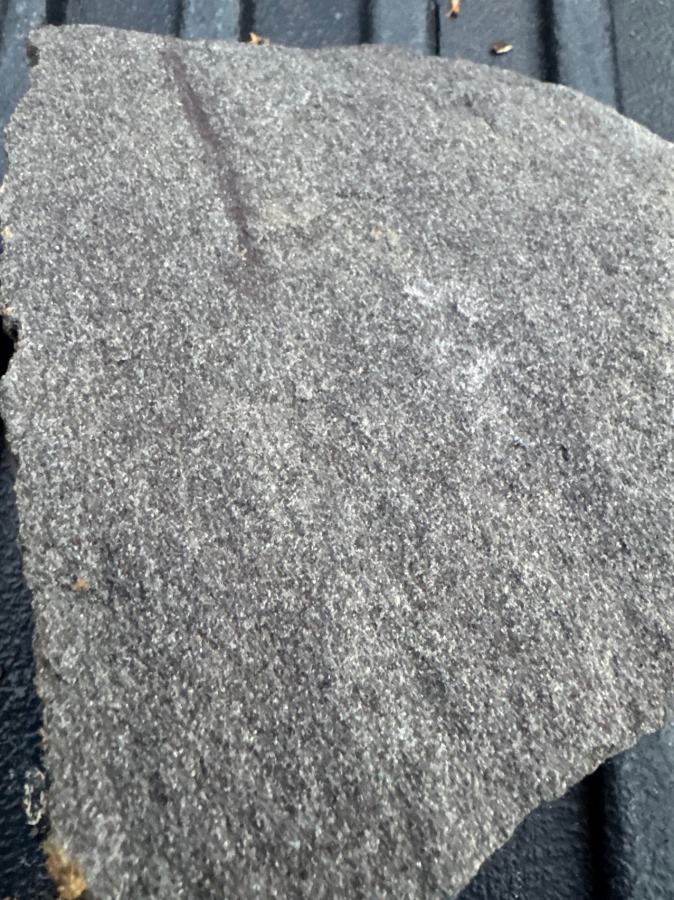
(yes, it’s Novaculite)
(shredded wood for eventual topsoil) – Look! ROCKS! and the best part is that they have already been blown up, crushed, shattered and stacked. I know that rocks, in their natural form, can be disturbingly large and aggressive if teased, especially during calving season. This sort of thing is a blessing and a curse because it’s got some of everything but there’s no locality left. So, if I found something that was 100% compatible with Japanese uchigomori I would still not be rich – I’d have to find more. Anyhow, it was interesting enough to get out of the truck for a look-see. GPT had made its usual list of good suggestions including that I take an old file, so I could see how any interesting rocks gummed up the teeth, or resisted a file, or attacked.

Then, I started finding a lot of “Pennsylvania Yard Rock” AKA: Binsei PA. a coarse, approximately 80 grit, stone with lots of quartzite in it (hard stuff) in a matrix of clay (goo) – basically, that’s very very close to what a sneaky Japanese stone-monger will sell you for $150 if it’s squared off and has a cool label. So, I stole a few chunks of various rocks – probably 130lb or so, maybe $.03 worth.
Some of this stuff turned out, actually, to be pretty darned awesome. Hence, my apology to badland. I hauled a few pieces around and tested them on a spare katana blade I had lying around. It turned out that it’s basically the same as a Japanese rock that cost $80 plus shipping. I also spent a while figuring out how to cut it (I know, chisel: hammer) I had a pretty goodly collection and spent some happy time cutting rocks and breathing dust and generally making a great mess out of everything while remaining conscious that (in principle) I was blasting abrasive all over everything and that I really should not wipe my glasses on my Tshirt.
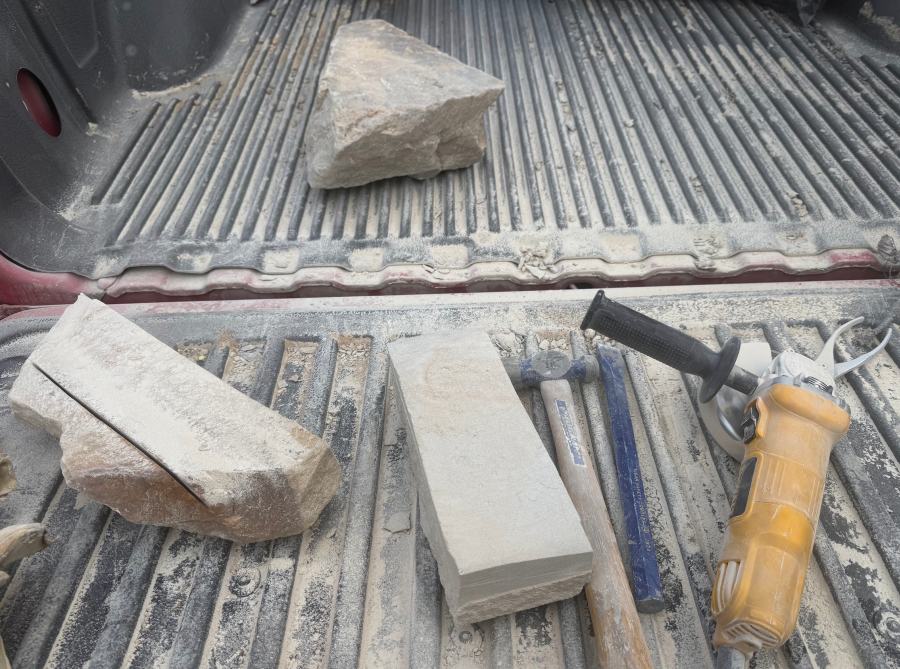
Then, The very next day I discovered this one super-sweet rock that was smooth as butter, made a delicious creamy clay, cut steel pretty fast, and was a fairly effective 200-grit foundation stone. Once I knew what I was looking for, I was able to go to the rock pile and steal a couple hundred pounds of that, and some other stuff. No, I did not swing by The Louvre in my distinctively dust-and-red colored truck (as if it would fit through Paris!).
All of this piqued a sort of excitement in me. I was doing what I love: learning useless stuff with no responsibility behind it. I now had a pile of neat looking beach rocks – it was time to give them away. So, I went to the post office and grabbed a dozen flat rate boxes. For $21 they’ll ship a box of rocks to anywhere in the US. I shipped 2 loads of boxes totalling around 75kg. In the process of doing this, I learned all kinds of crazy useless information, but really I was just setting my merest toe over the gigantic abyss of useless information that is Japanese-style sword polishing! Because of how the left-over flan in my skull seems to work, I can get very fixated on things, to the point where it’s hard to know where to stop. In other words, some of me is still the same. I have also developed a whole set of techniques for shaping hard rock with an angle grinder and a diamond wheel, that I’m pretty sure Japanese rock-shapers of old would have given a lot for.
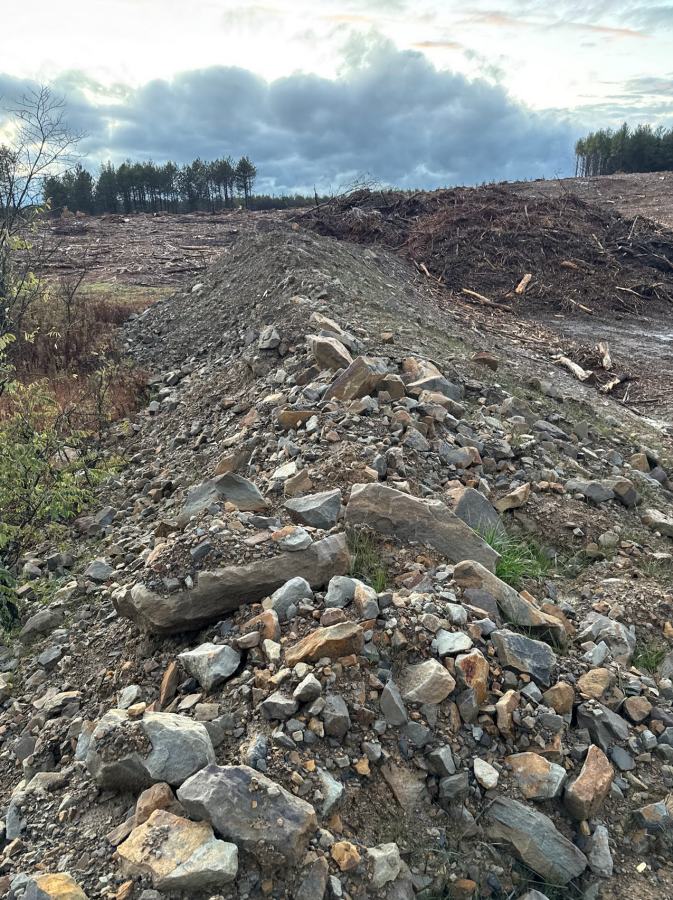
/me faints
You may not realize what a horrible thing it is, to get me interested in a topic. There is often collateral damage. I realized in the 1980s that the reason things are “interesting” is because they are connected to other things. So, in order to master an “interesting” topic you have to learn not just the thing but all the things connected to the things. But what does “connected” even mean? It means that there is some sort of underlying guiding theory that can explain how A somehow B because otherwise you’re being religious. This is true for all B unless all of physics is wrong. Those underlying guiding theories can be correct, or incorrect, but what’s fun is they can be verified to some degree or another. Hey, the relative amount of those sparkly things in a non-diamond sedimentary rock (those are quartzite) will affect the speed of how it cuts metal based on the quantity, and how evenly based on the distribution. Etc. Anyhow, I have been messing with this stuff for long enough that I went back to the 3 blades I need to polish, and suddenly whole new vistas of theory began exploding before me. The clay-ey stone produced a completely different effect from the less clay-ey stone. What the hell?
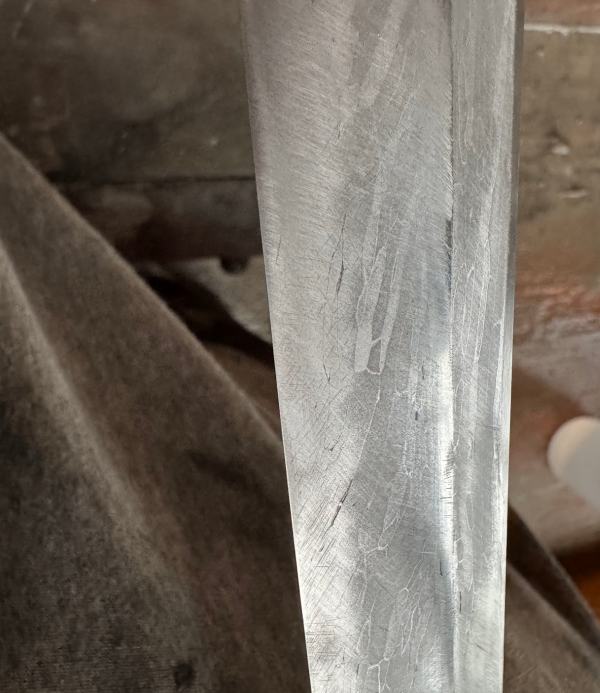
Well, well, well, – you can see the temper line on the left, because it’s much more deeply scratched than the right near the ridge-line (shinogi-ji) You can even see the hardness transitions in the flat. And you can see on the ridge-line that there are places that I simply haven’t hit on yet. I could give you a 4 hour lecture from that one photo, but I won’t. Anyhow, the edge, inside the temper-line (hamon) has scratches going in different directions because it has been hit with a variety of tools on the harder metal than the flat. So it’s more burnishing the finish than polishing it. See there are angled strikes, which are probably from the belt sander long ago, and straight deep ones most likely from a diamond stone. The ridge-line also carries hard-edged strikes, again probably that diamond block. But what about the shiny area with the diamond strikes? That’s an area that a lazy sword-polisher missed. So, what you do is start polishing the flat, but push your intentionality toward the shinogi-ji. After a bit, the line there becomes as sharp and as crisp as your stone is straight and flat. Please read that a few times. It took me dozens to write, so you owe me. Now look at the very bottom of where the shinogi-ji is leaving the picture frame – there’s an area that’s sharp and crisp on the flat/edge side but has an un-matte area on the other side. Well, if I polish with just a few strokes with my intention on the shinogi-ji, that line will pop off the surface like it was made on a CNC machine and polished with conspiracy theory dust. Like:
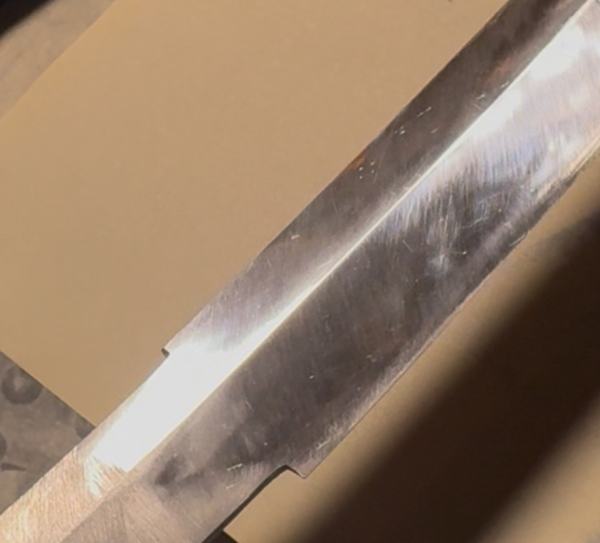
The flatter and smoother my rocks are, they correct themselves along both edges and the shinogi-ji becomes sharper and shinier. It must. When you understand this, it all starts to fall in place. Think back up to the blade with the big matte spots right behind the hamon – what are they? Simple: the abrasive mud is sharp enough to cut that metal, which is unhardened, and give it a matte surface, while the hamon just gets a little shinier. Where it gets fun: there’s a different way of approaching each edge on each type of blade, which is why someone who polishes long-swords (katana) and short-swords (wakizashi) might prefer not to polish a dagger (tanto) There are about a dozen blade geometries for those, and only about 6 for the swords. As the polishing block gets finer, the line gets more crisp.
So I get to this state where my blades look I have polished them with a chocolate bar, which is where the class in sword-polishing that I took, did not go. Naturally, I did what I usually do, which is proposed a theoretical framework (the metal matting because of differential hardness) to GPT and listened to what it had to tell me. Differential hardness is also unexpectedly interesting because you have 2 ways of making metal shiny (I’m gonna add: “at least” to cover my ass) one is to remove all the scratches until it looks like a mirror – polishing them – the other is to make the scratches pretty small and then bash ’em flat – burnishing them. I’m just gonna say that matte look with the polished highlights – that’s as tactical as anything fielded until the heyday of Rome.
And, of course, GPT told me what I should have expected, which is, since this is a process developed by the Japanese there is an infinite stack of layers of things you have to do in the right order, precisely, or you’ll have a scratch specific to step #8 which will be unremovable unless you go back to step #6. Not quite, but, maybe I am not entirely joking. Anyhow, it turns out that I’m pretty close to being able to go for a final polish, but any scratches I missed 3 steps ago will re-appear with little LED spotlights on them and a Rammstein stage show. I have come to understand, though, why a Japanese-trained master swordmaker can be handed a modern sword made by some well-meaning guy on the internet, and they just smile, “yes, indeed” and pass it back.
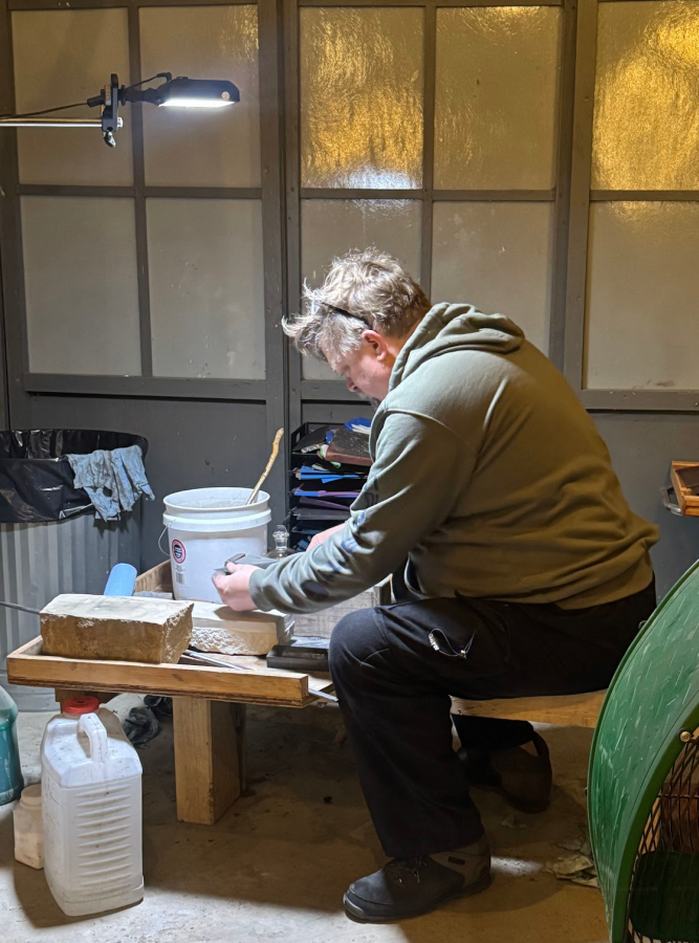
Anyhow, I have a new appreciation for rocks. And now I am mind-blown by the many sword-polishers in the world who figured this stuff out, and learned to make these glittering bars of death as glittery as they could be.

Oh, and, yes I did ship 10 flat-rate boxes full of rocks. It’s still not as bad as the anchor chain (iron is a lot heavier than rock!!) and I complained that the anchor chain box had broken open and wanted them to check for damage.
* I am not up to date with Arkansas class consciousness, really, so I shouldn’t touch that topic, either. But in case someone is about to write me a lengthy rebuttal like badland’s, please remember [stderr] I have a few historical credentials that allow me to survive (?) any rough-and-tumble in the comment section about class consciousness.
There is a video I saw somewhere, maybe Instagram, of some old-school whetstone makers. I had an epiphany when I saw one moment in it, where the guy has a thing like a hacksaw (OK) with a bronze or copper blade (OK) and at one point he pulls out a hammer with a kind of pick-like reverse-end, and starts banging a small tight line up the blade. Naturally, as a blade guy, I was about to freak out until I realized that that’s how you sharpen a bronze rock saw. I bet that somewhere in some Egyptian shop manual are instructions for how to do that. As the internet lapses farther into stupidity, Instagram keeps getting crap like “wow look at this really square rock! there is no way ancient humans could have cut that!!! therefore: ALIENS!” I suspect an ancient Egyptian artisan would have fetched him a tremendous clout upside the head.
In the same vein, this is a thing I saw that may never cease to delight me. It was a comment someone posted on Instagram saying that he and his new wife were discussing doing some tourism now that they were married. He mentioned Stonehenge, as it is a) a very british place and b) stone, etc. His wife apparently looked at him agape for a minute and finally managed to mutter, “your ancestors must have been weak and stupid.” That was when he remembered that she was Egyptian. I have a Chinese friend I have been discussing touring the USA with, and I realized that for someone who grew up with the Forbidden City less than an hour away by high speed rail, the USA is not going to be very impressive. We are at the weak and stupid stage, right now.
I’m pretty sure, now, that rocks have other uses than just sharpening things. They could be used to revolutionize structural engineering, maybe?
Given how expensive rocks are, why did they make a whole planet out of them? They should have used flan.
Lying, trying to sleep, oh my god. Something. Is. Wrong. On. The Internet. Can it be me!? AaaauuuHHHGGGHHHH!!
I should have mentioned somewhere that sharpening stones and polishing stones are not the same thing at all unless they are.
If you are intent on dropping down a rabbit hole, check out geologist Myron Cook on YouTube. Here’s one of his latest, on sand: https://www.youtube.com/watch?v=gZD5dfsAKzQ
ahcuah: I’m gonna pin the blame on you.
https://www.instagram.com/reel/DQtqN0gkgh_/?igsh=MTc2bWd2M3kyeTdjZw==
That is the instagram video of making old whetstones
If you want to make your stones really flat? Then here’s another rabbit-hole for you: “Whitworth three plate method“. :-)
Speaking of Stonehenge, I am currently reading the Roman de Brut, which relates that the Britons stole Stonehenge from Ireland, and they didn’t pay a tariff. The stones are originally from Africa, and were placed in Ireland by a giant.
Archaeologists/geologists say the altar stone from Stonehenge came from the northern Scottish islands.
Article: https://www.theguardian.com/uk-news/article/2024/sep/05/stonehenge-tale-gets-weirder-as-orkney-is-ruled-out-as-altar-stone-origin
One of the original research papers in Nature: https://www.nature.com/articles/s41586-024-07652-1
And while we’ve known for years that the blue stones came from the Preseli Hills in Wales, it’s comparatively recently that archeologists discovered that they came from a stone circle there, not straight from the quarry. They moved a stone circle.
Jazzlet@#7:
They moved a stone circle.
/Chinese: hush, we’re busy building this bigass wall we call “the bigass wall”
/Egyptians: We wouldn’t have finished those pyramids without the friendly aliens, too bad they all died of dysentery
/Chinese: Hey! look! the Welsh moved some stones while we weren’t watching.
I know the Chinese didn’t get properly stuck into the forbidden city until much later, but I think they should get some extra credit for making the staircase out of one 300 ton piece of rock that they moved 40 miles. Stonehenge’s rocks are around 30 tons which would attract notice from an Egyptian, I suppose.
And of course, the Chinese and Egyptians didn’t just build giant stone structures, they built bureaucracies that laboriously recorded all of the process of building the gigantic monuments, so that the descendants of man could look upon their works and say “aliens musta done it.”
The “Ancient Aliens” stuff always seemed like just so much racism to me, also mixed with a healthy dose of Dunning-Kreuger. People who have never in their lives attempted to work stone, or to move any object heavier than a bigscreen TV think about people who worked their entire lives with stone and hand-tools and think “Well, I know a lot more facts about the world than that person does, so I must know more than they do about their livelihood. Clearly they couldn’t have figured out how to move super-heavy objects, since I can’t think of a way to do it with the tools that I imagine they had.”
Of course, most modern people couldn’t figure out how to safely move a 30T boulder if you gave them a 150Tonne crane and a sea-can full of top-of-the-line rigging supplies.
Our ancestors had access to fewer facts and much less trivia than we do, but they were no less intelligent than we are. A man who spent his entire life working stone, quarrying stone, transporting stone… this man knows more about how to move super-heavy objects than I will ever understand, and I’ve done some heavy moving work. I’ve also done quite a bit of it with tools very recognizable to our ancestors, to wit a sturdy prybar and some rollers. You’d be amazed what you can do with leverage and simple machines. There’s some tremendous satisfaction when you can start a 90KLb object inching along using just a 6′ prybar.
Obligatory Ylvis: Stonehenge (2013)
(could someone tell me wtf is up with the hand at 0:23??)
not much to add…
thought this was an interesting post.
And seconding pretty much all of snarkhuntr’s@9 – so much racism and lack of problem-solving ability.
Thanks to stderr and Ahcuah @6, re-read the stuff on that 6-tonne rock at Stonehenge originating in Orkney, and now looks like it’s from somewhere else but still close by. Having the good fortune to live nearish to Orkney and visiting, I totally fail to visualise the infrastructure you would be needed to transport a 6 tonne rock by a coastal route. The sites on Orkney show they were smart, skilled, organised, but, …how the actual f*** did they do float 6 tonnes of rock hundreds of miles. Never mind why? You need at least 12 tonnes of dry-ish wood for a raft. Boats? How? 20+ leather coracles??? I know they were bright, and (according to Ahcuah ref) there was (sea) trade with Europe, but that rock delivery is mind-blowing. Any other refs or ideas?
I’m sure there are more elegant ways to manage it, but as a first attempt, I’d just try encasing the stone in logs/timbers until you had enough to get it to float, and then tow/guide it to where it’s needed. That would have the bonus of the logs protecting the stone from accidental collisions and such.
I was wondering if it could have been a glacial erratic, or if maybe sea level was low enough for land transport, but the article briefly explains why it’s unlikely to be a glacial erratic, and stone henge is too new (ha) for sea level to be much different…
lochaber@#13:
I’m sure there are more elegant ways to manage it, but as a first attempt, I’d just try encasing the stone in logs/timbers until you had enough to get it to float, and then tow/guide it to where it’s needed.
I am trying to visualize that, and with a lot of practical sympathy. The story begins, as it must, with the bunch of us and our big rock lashed to a sort of sledge with what we must call “ropes” by any other means. Perhaps even enough to have broken out a perfectly good gooey something-hide and sawed it into strips. Damnably tough those something-hides, uh, where was I…? Right, oh, shit is has sunk into that mud over there I told you to avoid you duffin! Since I am chief of this travails-party, I say we should add another log to it, because it’s positively ready to float. What do you MEAN!? Well we needed a more floaty log! Add another MORE FLOATY LOG with all the rapidity our pathetic gestural language can convey!!
God! Don’t let it too far out to sea!
(pausing for a moment to decide whether to post or no)
I have just realized that reality is an infinitely fractal connected series of disasters that were overcome and withstood in detail, unless they killed everyone.
The instagram video on whetstones was particularly gneiss.
I’ve used many abrasives to polish metal and rocks in my life, but they all seem to be made of rocks (pumice, garnets, diamonds) or metal oxides. The mini sandblaster uses aluminum oxide, and I use an optical grade cerium oxide as my final polish on SI02. It is tedious but crucial to go through all the grits very carefully before you can begin the three step polishing process, which will highlight every single scratch you missed. If done well, the rock seems like it does flow and burnish into a perfect glossy surface.
The ‘clay’ that results from honing a stone is technically called slurry.
As for Stonehenge, the current version was built surrounding the older stone circle made from the stone from Wales. It sits among an entire landscape of other ancient barrows, a cursus, and a similar structure known as Woodhenge which is just up the Avon River. The newest parts of Stonehenge are a fair bit older than the pyramids, and the oldest bits were remodeled so nobody knows just how old it is.
They had oxen, cattle, and pigs. Aurochs weren’t extinct. They could have used log rollers and animals power to move the stones and then rafted down the coast and up the Avon.
The technology of making cordage and rope was well advanced long before humans migrated into Britain. Linden trees and hemp are typical plant fiber sources. I’m pretty sure there are bone rope making tools in the archaeological finds from Stonehenge, in addition to thousands of picks made from deer antlers.
Ok I clearly expressed my self badly there. The people in Wales went to a lot of trouble to build themselves a stone circle, and used it for whatever it’s purpose was. That purpose must have been important because you don’t put that the sustained effort of a lot of people into every day stuff. Then at some point what? The result of ‘what’ is that you agree to your important place being moved. I’m not amazed at the stones being moved- we already know they could do that because they did it when they built the circle in the first place, I’m amazed at whatever the place meant being moved. It would be like moving Notre Dame Cathedral and all that it means now. I mean look at what happened after the bombing of WWII, cathedrals were rebuilt or in the case of Coventry cathedral built in the same ‘holy’ places they had always been in, it was literally to believers ‘hallowed ground’.
And yeah how the hell you get that chunk of rock across the sea does amaze me, even once you’ve solved the floating problem you’ve got currents and weather and motive power to solve.
As to getting a big rock to float, I didn’t mean trial and erroring it out, but I wasn’t clear about it. I mean, these people decided to relocate a stone circle, so they clearly had some understanding of what it took. Just being able to quarry out a rock of such a size takes a significant amount of problem solving. I’m sure they could have modeled it with smaller rocks/trees, and gotten a good starting frame to make an estimate of the timber needed. Hell, maybe they strapped it to a couple logs, and pushed it into a big artificial puddle, and waited till winter for it to freeze, and just tugged the rock on an artificial ice floe to where they needed it.
Just that they accomplished such a feat, seems to me that they had plenty of labor-hours to throw at it, and that alone can make quite a few ridiculous-seeming scenarios more reasonable.
Or maybe they just convinced a friendly giant to swim over there with it…
these people decided to relocate a stone circle, so they clearly had some understanding of what it took
Nobody who actually understood what relocating a stone circle took, tried to relocate a stone circle, but there were a lot of optimists.
I did get on the other side of a 12-ton rock wrapped ’bout with a cargo-strap, around the front axle of a Massey-Fergusen tractor sunk balls deep in a piece of Maryland, and to increase the pull was another cargo-strap around the axle of the thing, then a beam to a railroad tye. An’ Mick shouts “Hal Put It Over!” and Hal put it over like it had never been, and I swear nobody ever saw the end of that railroad tie again.
There needs to be a proper sport and rules.
Probably still crews stumbling about to know something about who owns that longship what was found 4 miles inland, and they married the viking girl out of respect.
#13 lochaber
A little elegance pays off. Any of those timbers that were above the water line would be adding weight without contributing flotation.
—
Knife sharpening gets tactical:
Resharp
And how does it assess the requirements of your knife? With a laser!
Of course it’s in matte black. Don’t insult me by asking.
Jazzlet@17.
Who said they agreed? I am reminded of Mary Stewart’s Merlin Trilogy, or the Arthurian story from Geoffrey of Monmouth: Merlin stole the stones (from Ireland, not Wales, but close enough for ancient legends) because of their great magical power.
Newgrange in Ireland is Neolithic vs the Bronze Age era of Stonehenge and the Pyramids. It’s rather impressive as far a monumental architecture goes, especially the solar alignments and the decorative carvings on some of the megaliths.
https://www.newgrange.com/
Apparently there are about 1300 stone circles across Great Britain, Ireland, and the Brittany region of France.
There are 6 on the Channel Islands, so obviously the ring builders were fairly skilled at boat building and sailing in open seas.
It’s impossible to say if the bluestones were relocated by the same people who quarried and erected them originally. Including the stone from Scotland could have been a way to express unity between the various groups. Equally, it can be interpreted as a visual way of marking territory/form of conquest similar to building Norman castles all over England.
There is a genetic change in British populations during the Bell Beaker Period.
What did you mean they are northerners? They are Germans from the Eifel.
This channel has the original video and many similar ones.
The men making the millstone are speaking French.
Marcus grew up in Southern France, so yes, the Eifel would be north. It looks very scenic.
The video was filmed at a Basalt Quarry in Mende, France.
https://www.mindat.org/loc-238505.html
I especially enjoyed the part where they casually slid a multi-ton millstone blank off the side of a cart, and the little victory yell when they shoved it onto the block platform and it landed perfectly.
The changing pitch of the stone as they work it was interesting. I didn’t know basalt could ring like that.
@Tethys
Nope, that’s German. I can clearly understand them.
Nope, it’s the Basalt Quarry at Mendig, as they say in the beginning, which is in Germany.
If you need proof, here is the original video they stole from .
To the words of “Oh, der kippt um.” “Nein, nein, nein, tut der nicht.” “Schaffst du?”
“Drei!” “Hup” “Gut!” “Der liegt!” “He he he he!”
Sound very French to you?
Meanwhile, I’ve been trying to learn how various kinds of whetstones got made. It turns out that the rarest and hardest to find (uchigomori) happens when you have a large amount of fine volcanic ash get squished down into sandstone, resulting in a very pasty fine sandstone that is soft and filling – it doesn’t just cut on a single surface it cuts a larger area, but the area is progressive. So if you imagine a line being pressed on the stone with a force of 10 somethings, the abrasion is 10 at the line, then 5 a few microsomethings away, then 3 then 1 then 0. What that does is abrades not just the high parts but also very close adjacent lower parts – perfect for dealing with transition zones like the hamon. Uchigomori appears to basically have happened in one place that has ever been discovered, so it’s kind of like that little island of perfect granite from which all the curling stones are cut.
The result of ‘what’ is that you agree to your important place being moved.
“HEY! Our property line used to be over there! Uh, look at the maa… aw shucks.”
Aha! Here it is!
https://www.instagram.com/reel/DQtqN0gkgh_/ on instagram.
The part that threw me for a few is around 00:30 where the guy starts chiseling on the edge of his saw. Then, I realized, he’s sharpening it.
I bet those old coots’d sit up in awe if they could see how fast an angle grinder with a diamond wheel cheeses through sandstone. It’s like brie.
Amateurs, this is how you sharpen saws.
The literature of pre conversion Northern Europe has many references to gray whetstones and millstones. Thor still has a fragment of one imbedded in his face after battling Hrungnir. Odin uses another to trick six slaves using scythes into slaughtering each other. There is a whetstone incorporated into a scepter which was excavated from the Anglo-Saxon Sutton Hoo ship burial. It has carved faces on the ends. Describing things as gray seems to imply that it’s a bit sinister.
https://www.britishmuseum.org/collection/object/H_1939-1010-160
There is an entire ljóð about a millstone called Grotti and the two women Fenja and Menja.
It’s so filled with puns and double entendres that it’s almost vaudevillian.
https://en.wikipedia.org/wiki/Grottas%C3%B6ngr
—
Here are some stone masons working granite in France last month. They have modern diamond saws, and an array of hammers and chisels. The head mason looks like a cousin to the guy in the historic video who says “Alons!” , complete with the traditional cap. I enjoy watching the expert craftsmanship, but I cringe at the lack of eye protection.
The masons are at 7:20. You also get a good shot of the unusual hexagon shaped granite blocks in the wall behind him. The foundation has since been sandblasted in preparation for pointing and it gleams as if it’s brand new. Gotta love building materials that still look great after hundreds of years.
https://m.youtube.com/watch?v=svyTRBhRYh0