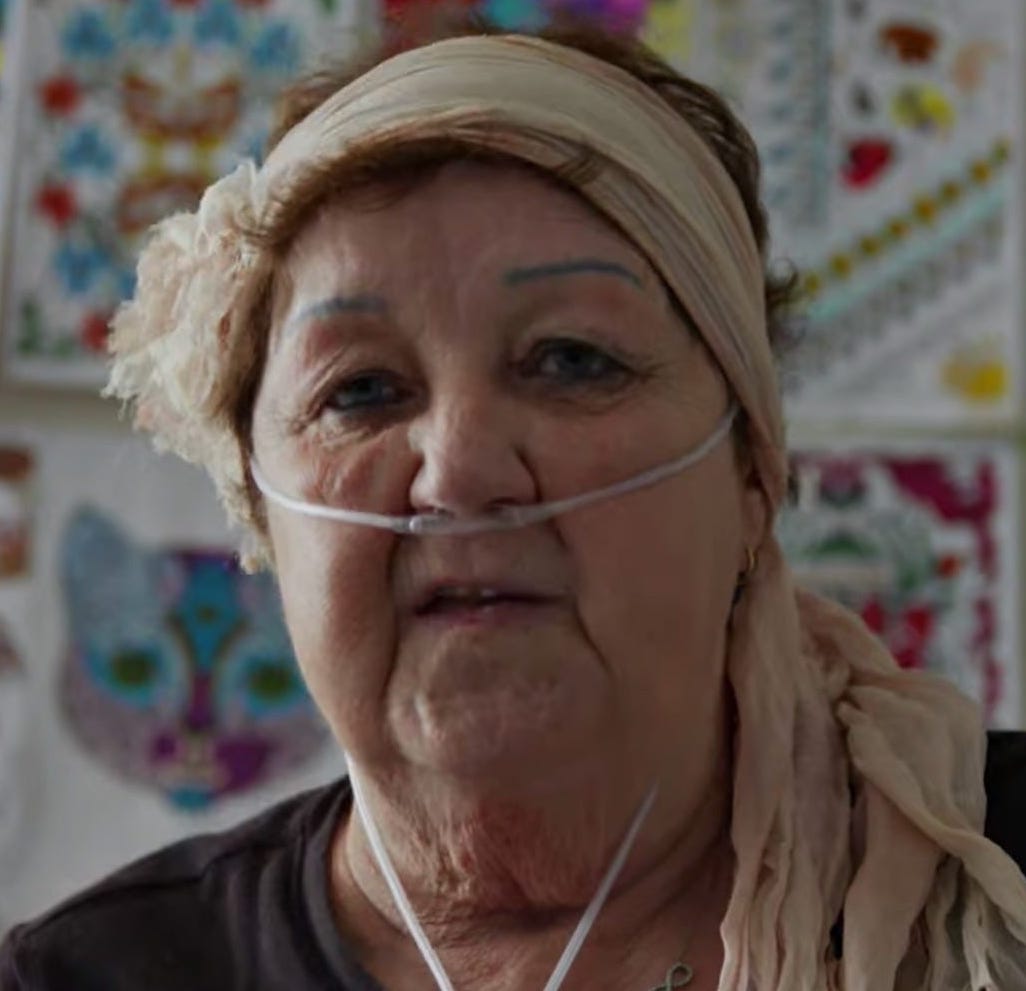
Norma McCorvey, who fought for the right to an abortion in Roe v. Wade, and then flipped to crusade against abortion under the influence of evangelicals, flipped again before her death — she was bought and paid for by the Religious Right.
In the final third of director Nick Sweeney’s 79-minute documentary, featuring many end-of-life reflections from McCorvey—who grew up queer, poor, and was sexually abused by a family member her mother sent her to live with after leaving reform school—the former Jane Roe admits that her later turn to the anti-abortion camp as a born-again Christian was “all an act.”
“This is my deathbed confession,” she chuckles, sitting in a chair in her nursing home room, on oxygen. Sweeney asks McCorvey, “Did [the evangelicals] use you as a trophy?” “Of course,” she replies. “I was the Big Fish.” “Do you think you would say that you used them?” Sweeney responds. “Well,” says McCorvey, “I think it was a mutual thing. I took their money and they took me out in front of the cameras and told me what to say. That’s what I’d say.” She even gives an example of her scripted anti-abortion lines. “I’m a good actress,” she points out. “Of course, I’m not acting now.”
The two jackhole Christians who ran the scam are both horrified, but split: one because the end justifies the means, the other because he actually has some moral principles.
Reverend Schenck, the much more reasonable of the two evangelical leaders featured in the film, also watches the confession and is taken aback. But he’s not surprised, and easily corroborates, saying, “I had never heard her say anything like this… But I knew what we were doing. And there were times when I was sure she knew. And I wondered, Is she playing us? What I didn’t have the guts to say was, because I know damn well we’re playing her.” Reverend Schenck admits that McCorvey was “a target,” a “needy” person in need of love and protection, and that “as clergy,” people like Schenck and Benham were “used to those personalities” and thus easily able to exploit her weaknesses. He also confirms that she was “coached on what to say” in her anti-abortion speeches. Benham denies McCorvey was paid; Schenck insists she was, saying that “at a few points, she was actually on the payroll, as it were.” AKA Jane Roe finds documents disclosing at least $456,911 in “benevolent gifts” from the anti-abortion movement to McCorvey.
Reverend Benham then blurts out, “Yeah, but she chose to be used. That’s called work. That’s what you’re paid to be doing!” Schenck’s thinking is quite different: “For Christians like me, there is no more important or authoritative voice than Jesus,” he explains. “And he said, ‘What does it profit in the end if he should gain the whole world and lose his soul?’ When you do what we did to Norma, you lose your soul.”
In fact, Reverend Schenck underlines his own conversion, which took place in the last decade: “I still identify as an evangelical, but I like to think of myself as lovingly critical of my community. I guess in some ways I’d like to use whatever years I have remaining to undo the damage that I did and that many movement leaders did on the pro-life side. I used to think that Roe v. Wade would never be overturned. I think Roe v. Wade could be overturned now. And I think the result of that would be chaos and pain. And to impose that kind of crisis on a woman is unthinkable.”
Fortunately, the pro-choice cause does not rely on the bought testimony of individuals, but on the autonomy of all women.