
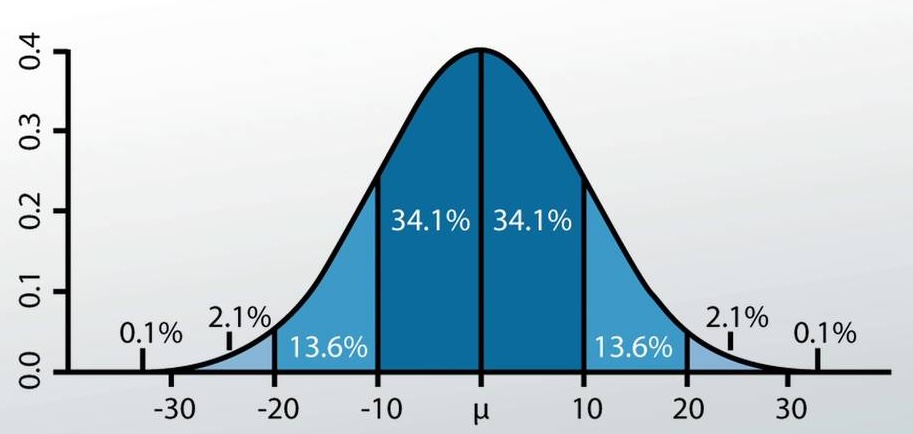
All of my students are above average, and handsome, too
The students have survived their first genetics exam, everyone passed, hooray! Now I have to figure out went wrong in the problems they missed, and shore up their weaknesses in the next week.
First thing I notice is that they are rock solid on simple Mendelian genetics, but that’s not a surprise. Mendelian genetics is dead easy, which is why I have to roll my eyes when I see racists and eugenicists babbling out terms from high school genetics — it’s all the later, more sophisticated stuff that trips them up every time. Getting cocky about the basics is a sure way to fail when reality makes its ugly appearance.
What I really have to work on are probability and statistics. Some of the students are unclear on what a p value implies, and they’re getting tripped up by simple things, like the binomial theorem. I had no idea when I got my biology degree that I’d end up having to teach math!
(Really simple math, too. High school teachers, make sure your students are aware that biology is not a math-free discipline!)

No surprise there. Physicians mostly don’t know what a p value is and they don’t understand Bayes theorem. Actually, I would say that most people who do clinical research don’t understand the meaning of a p value, which by the way I would like to see a lot less of. Go with Bayes.
Isn’t grading one of the most dull, soul-crushing element of teaching ? (my sister teaches chemistry)
The upside must be learning about the progress of former students ( if they keep in touch).
Anyway, I found math to be one of the more fun activities of university. But it helped if you had friends you could consult when you inevitably got stuck.
I often describe myself has having been a biologist who spent his day in front of a computer when that was unusual.
The 80’s and 90’s utterly transformed the way approach biology. Speaking of an observation that is significant with a p-value of 0.05 is more accurate than saying “yes, it’s there”, but much harder for people to grasp.
It was realizing that I really had to do a unit on exponential notation in the midst of a college senior-level biomechanics class that… um… gave me pause. 1.23 x 10^6 really is bigger than 4.56 x 10^3. Who knew?
I spent a significant amount of my working career doing applied statistics. I was always amazed at how little people with PhDs knew about how to apply statistics to their field, I’m talking Physicists, Chemists, Electrical/Mechanical engineers, and even other math dweebs. I just don’t think applied statistics (think linear/nonlinear regression, time series, design/analysis of experiments, probability analysis) is taught outside the statistics community. There should also be some basic optimization strategies from operations research areas taught too. At least enough to let non-stat people realize there is a lot they don’t know and that it might be useful to partner with some applied stat folks.
cervantes–
Not saying this to diss Bayesian theory, but it has its own flaws (brittle priors, overconfidence with small data sets), and as the data set enlarges, the Bayesian credibility intervals and the frequentist confidence intervals tend to converge anyway.
I expect that if Bayes had become the dominant statistical methodology in science, we would have just as many people not understanding it, data hacking to get better credibility intervals, and so on, and plenty of frequentists complaining that if only people used p-values, we wouldn’t have all these misapplied Bayesian stats.
That is, I don’t believe most statistical misuse is caused by the philosophical complexities in either Bayesian or frequentist stats. After all, the concept of p-values is not all that difficult to understand, even if the interpretation needs care, any more than the concept of choosing sensible prior probabilities, which seems obvious to me, has been wildly abused by people trying to prove their own prejudices. Most misuse of stats is out of ignorance (desire to process data without going to the trouble of learning how), career boosting (hacking data until it’s publishable), or self-reinforcement (boosting personal beliefs with bad stats).
A half credit of statistics needs to be a requirement for a high school diploma.
Does anyone understand p-values?
More evidence that even top researchers routinely misinterpret p-values
jkrideau@8–
That’s a very interesting paper. It has some serious flaws, but the key finding is that researchers changed their answers depending on the quoted p-value. This suggests that the respondents’ interpretation of the wording depended on the p-value, which is a concern.
However, as your linked correspondent (a very Bayesian statistician btw) notes, “I’m sure researchers would also misinterpret Bayesian inferences to the extent that they are being used in a null hypothesis significance testing framework.” Which I’m in agreement with.