Practice and sight-reading in video games

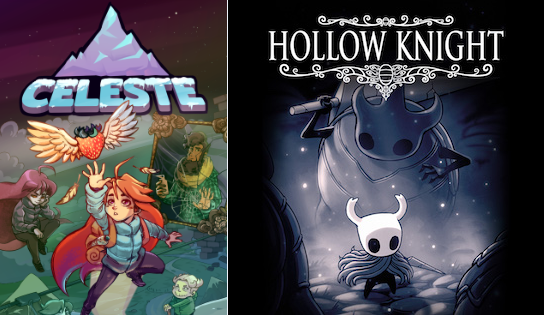
Earlier this year, I played Celeste and Hollow Knight, two critically acclaimed platformers released in 2018 and 2017 respectively. Games critics basically talk about these games all the time, so I knew what they were and I knew they were quote-unquote “good” games. But they’re outside my wheelhouse, in that they are not puzzle or story games. So I only played them recently, and only because my husband bought them for himself.

In both games, I noticed a difference in how my husband and I played. Initially, my husband would play, and then I got interested. I would skip ahead of my husband in leaps and bounds. But eventually, towards the end, my husband got better than me. He would start consistently beating challenges that I could only beat after many tries, and would reach further through the post-game content. What gives?

box art for celeste and hollow knight

Image credit: Wikimedia Commons (1) (2)

Both of these games present very difficult technical challenges, where you have to input a precise series of moves or react quickly to what you see on screen. They both promote the feeling of mastery once the challenges are complete. They are both very good at what they’re trying to do. Celeste in particular was a favorite for both of us, because instant respawns greatly reduce the friction to achieve that feeling of mastery. But my husband definitely enjoyed them more than I did, and I think it has to do with our different learning curves and learning styles. It may also explain why I don’t care for games that emphasize technical mastery, and go more for those puzzle and story games.

[Read more…]

How my free time disappeared

This article was written for the Carnival of Aces, which this month had the theme of “quarantine”.

Back in February, I got a new job. I like my job, but my main complaint was the long commute–over an hour and a half in each direction. My husband had an even longer commute, so we were in the process of looking for a new apartment in a better location.

In March, my company told everyone to work from home. My husband’s company did the same. Suddenly we had all this extra free time, multiple hours every day that we would have spent commuting. But all that extra free time–and more–got immediately slurped up.

Although it could be said we’re all in this together, I’ve noticed some stark contrasts in the way that COVID-19 has impacted our personal lives. There are those who lost their jobs or were sent home from school, and there are those who kept their jobs and now have to take care of their kids at the same time.

In the ace community, you might expect that since few people have kids, people gain free time rather than losing it. But as someone who keeps track of ace community activity (for linkspam purposes), I’ve observed a precipitous decline in activity in March and April, followed by a slow recovery in May. Other people have noticed it too. I’d like to offer my own experience as a case study of why this might have happened.

[Read more…]

Hoarding is my ultimate boss in Animal Crossing

In early April Animal Crossing: New Horizons celebrated Bunny Day, a secular analogue to Easter. During this event, pastel-colored eggs could be found everywhere, and could be used to craft colored-egg-themed furniture and clothing. This was not entirely well-received by fans, because the eggs would replace other ordinary crafting items, and because the furniture is ugly.

For my part, I crafted every single Bunny Day item, and stuffed them all in a room.

Room filled with pastel-egg themed furniture

And then as soon as the event was over, I sold every single Bunny Day item, and whatever eggs I had remaining. As someone who grew up with a hoarder, I found it cathartic to take all that exclusive special-edition ugly junk, and throw it in the garbage.

Then, I redecorated the room to look like a landfill. [Read more…]

Heaven’s Vault, Disco Elysium

My blog has hit a bit of a slump–the coronavirus has taken the wind out of everything that isn’t itself. But if I were to examine the more direct causes for the slump, I’d have to look at video games. Yes, I’m playing video games instead of blogging. Well why don’t I blog about video games?

In the past month, I played two narrative video games: Heaven’s Vault and Disco Elysium.  These are my brief reviews.

Heaven’s Vault is a game about an archaeologist trying to understand the collapse of an ancient civilization. It takes place in a low-tech sci-fi environment where people sail between the “moons” of a nebula, but only really through the use of ancient tech. This game features four main gameplay loops: sailing between moons, exploring sites, dialogue trees, and translating ancient text.

[Read more…]

Election meta

cn: more board gaming than election politics, really

Usually around election time I write up a post about what I’m voting for on the ballot. Most things on the ballot are local, and not relevant to most of my readers, but I think it’s important to highlight and normalize the research process for smaller elections. The presidential election is important and all, but in all likelihood you’ve already made that decision so surely you can spare some time to research the smaller elections?

Unfortunately my last ballot didn’t really have any interesting local votes, so I guess we’re stuck talking presidents. Well shoot.

You know what, I want to talk about board games instead.

In games with three or more players, players are often presented with a choice to attack one of their opponents. This opens up a fair amount of strategic space, which board gamers sometimes sometimes refer to as “politics”. Common political strategies include:

[Read more…]

What drives walking sims?

“Walking simulator” was originally a derisive term, coined in the days of gamergate, referring to a set of minimalist games where you simply walked around 3D environments. By now, a lot more games in this category have appeared, and while not universally beloved, they’re more or less accepted as a part of the video game landscape. And I find that I rather like this genre myself. I’ve played quite a number of walking simulators over the years, and still others I’ve watched on video or have seen critical discussions.

The question I’d like to ask today is, what is the appeal of walking simulators? What drives them?

I am thinking in analogy to drone and ambient music, which strips away many of the components that people conventionally enjoy in music. But what motivates drone/ambient music varies greatly depending on the work. Contrast Brian Eno’s Music for Airports, which wants to blend into the background, with Sunn O)))’s Monoliths and Dimensions, which wants to mesmerize. Walking sims are also a genre full of contrasts, and I’d like to identify several different goals that they may have.

[Read more…]

First player advantage

People liked my article, “Chess involved luck, and other propositions“, so I’d like to add a bit more discussion on a related topic.

In turn-based games like Chess, there’s a slight asymmetry between players, in that one of the players moves before the other one does. And moving first seems to be an advantage. This has been demonstrated through statistical analysis of various chess tournaments and databases. Depending on which data are used, the first mover wins anywhere from 52% to 55% of the time.

First mover advantage can be considered as third factor, independent of either luck or skill. If you flip a coin to decide who goes first, then first mover advantage is one component of luck. But it’s the sort of luck that you can eliminate by say, choosing a tournament structure where players alternate white and black.

There’s apparently a lot of historical discussion of first mover advantage in chess, but at this point I may as well drop the pretension that I know anything about chess. The game that I’m a lot more interested in, is competitive Dominion. Dominion is a turn-based game, and also has a first player advantage. The community compiles a ton of statistics from games online, and the statistics show that in two player games among top players, the first player wins about 58.8% +/- 0.2% of the time (excluding ties).

[Read more…]