Via Out. To say this is powerful is an understatement.
Affinity
Art, Fun, & Nonsense.

Via Out. To say this is powerful is an understatement.
Do your bit in pissing off a Tiny Tyrant, and let him know we don’t want to live on the Eve of Destruction.


© C. Ford.

Getty images – Simon and Schuster.
Gyasi Ross has an excellent article up about Crispus Attucks, and the shared narrative between Black people and Indigenous people.
Since white colonization of this continent, Black and Native lives have always been valued less than other people. The story of Crispus Attucks was an early illustration of how there seems to always be a reason why black and Native people get killed that somehow exonerates the authorities of guilt when they harm us. “Self-defense.” But, perhaps most importantly, the story of Crispus Attucks is about combined Native and black lineages that resisted, suffered, but through that resistance caused a revolution.
The year was 1770 and the scene was the Massachusetts Colony. Boston was hot with anger and resentment toward England. 150 years after Pilgrims originally occupied the homelands of the Wampanoag people, the descendants of those Pilgrims felt like they were losing control of the land they called “home.” At that time slavery was legal in the Massachusetts Colony—white colonists enslaved Natives and blacks alike in Massachusetts. For example, in 1638 during the so-called “Pequot Wars,” white colonists enslaved a group of Pequot women and children. However, most of the men and boys, deemed too dangerous to keep in the colony. Therefore white colonists transported them to the West Indies on the ship Desire and exchanged them for African slaves.
[…]
Crispus Attucks was both Indigenous and black and a product of the slave trade. He was brilliant in the survival skills that is common and necessary amongst both Indigenous people and black people since the brutal regime of white supremacy came to power on Turtle Island. His mother’s name was Nancy Attucks, a Wampanoag Native who came from the island of Nantucket. The word “attuck” in the Natick language means deer. His father was born in Africa. His name was Prince Yonger and he was brought to America as a slave.
Attucks was himself born a slave. But he was not afraid to actively seek his own (or others’) liberation. For example he escaped from his slave master and was the focus of an advertisement in a 1750 edition of the Boston Gazette in which a white landowner offered to pay 10 pounds for the return of a young runaway slave.
“Ran away from his Master, William Brown of Framingham, on the 30th of Sept. last, a Molatto Fellow, about 27 Year of age, named Crispas, 6 Feet two Inches high, short curl’d Hair…,”
Attucks was not going back though—he never did. He spent the next two decades on trading ships and whaling vessels.
[…]
The story of Crispus Attucks is powerful. Native and black people have been facing the same tribulations and common enemies for a very long time. For most of the time since white people have been on this continent, black folk and Native folk have had no choice but to work together and have. If we look at statistics today—from expulsion/suspension from schools, to the blacks and Natives going to prison, to getting killed by law enforcement—not a lot has changed. We still share very common narratives and need each other.
We still need to work together.
Click on over to Indian Country Media Network for the full article.

A still from Arke’s 1996 video Arctic Hysteria shows the artist naked and crawling across a photograph of Nuugaarsuk Point in Greenland. Photo courtesy of the Louisiana Museum of Modern Art. Acquired with funding from Anker Fonden Poul Buchard/Brøndum & Co.
Most people have never heard of Pia Arke, which is a shame, because she was an artist who took on one huge subject: the colonial takeover of indigenous peoples by those who termed themselves “explorers” and “discoverers”. There’s a great deal of horror inherent in any indigenous peoples experiences with colonialism. Unsurprisingly, indigenous women got the worst of it.
In the spring of 1995, Danish-Greenlandic artist Pia Arke was digging through the archives of New York City’s Explorers Club. She was searching for maps, ethnographic images, and scientific miscellany that she could repurpose into collages that confront Greenland’s colonial past. Arke knew early 20th-century adventurers often, by turns, demeaned and romanticized her Inuit ancestors. Even so, one photo from American explorer Robert E. Peary’s collection shocked her: a native woman, topless and screaming, restrained by two fur-clad and seemingly untroubled white men. A curator told Arke the woman could have been suffering from a madness called Arctic hysteria.
More than 20 years later, Arke’s mesmerizing film Arctic Hysteria, which she created the year after she found that dark photo, was looping endlessly in an alcove at Denmark’s Louisiana Museum of Modern Art. Situated in a small town along the Baltic Sea about 50 kilometers north of Copenhagen, the Louisiana Museum enjoys the kind of international acclaim that makes it a dream exhibit space for most artists. Arke’s work was part of last year’s star-studded exhibit Illumination, which featured such luminaries as Ai Weiwei, Cindy Sherman, Jeff Wall, and Gerhard Richter. The flashiest Arke piece on display was Legende I-V, a series of five collages of Greenlandic maps and sepia-toned family snapshots layered with imported commodities such as rice, sugar, and coffee. Legende I-V is physically imposing—it dominated an entire gallery wall—and hauntingly beautiful. The foodstuffs function both symbolically and texturally, the photographs evoke the warmth of kinship, and the cartographic lines of Greenland, stamped with place names referencing colonial explorers (Peary Land, Humboldt Glacier, and Kane Bassin, for example), loom insistently over everyone.
Arke’s Arctic Hysteria is equally magnetic. The performance, which lasts six minutes, is silent and consists almost entirely of one scene: Arke crawling naked across a giant black-and-white photo of Nuugaarsuk Point, a spit of land at the terminus of a C-shaped bay. The artist lived there, outside the small town of Narsaq, Greenland, with her parents and siblings in the late 1960s. In the video, Arke strokes the artificial landscape, rolls across it, and sniffs it like an animal. Then she methodically rips the entire thing to shreds, gathers the curled shards of paper, and lets them fall across her shoulders and thighs. The intimacy of the performance and the title’s historical allusion are classic Arke.
[…]
Historical context points to alternative interpretations. Inuit women labored at the very bottom of the social hierarchy on Peary’s expeditions and in his camps, expected to sew, fish, carry wood, and submit to the Americans’ sexual desires. Peary, for example, fathered two sons with his Inuit laundress, Ahlikasingwah. His navigator, Robert Bartlett, viewed one woman’s hysteria as simple protest, or “pure cussedness.” Accounts described women who seemed intent on escape or dissent leaping over the ship’s railings or shouting for a knife. Expedition member Donald MacMillan recounted finding a woman named Inawaho naked and screaming, presumably unaware of her surroundings and out of her mind. But as soon as MacMillan pulled out his camera, Inawaho hurled huge chunks of ice at him and later begged him to destroy the photos. Were these women, in fact, crazy? Or were they reacting perfectly rationally—even bravely—to their circumstances?
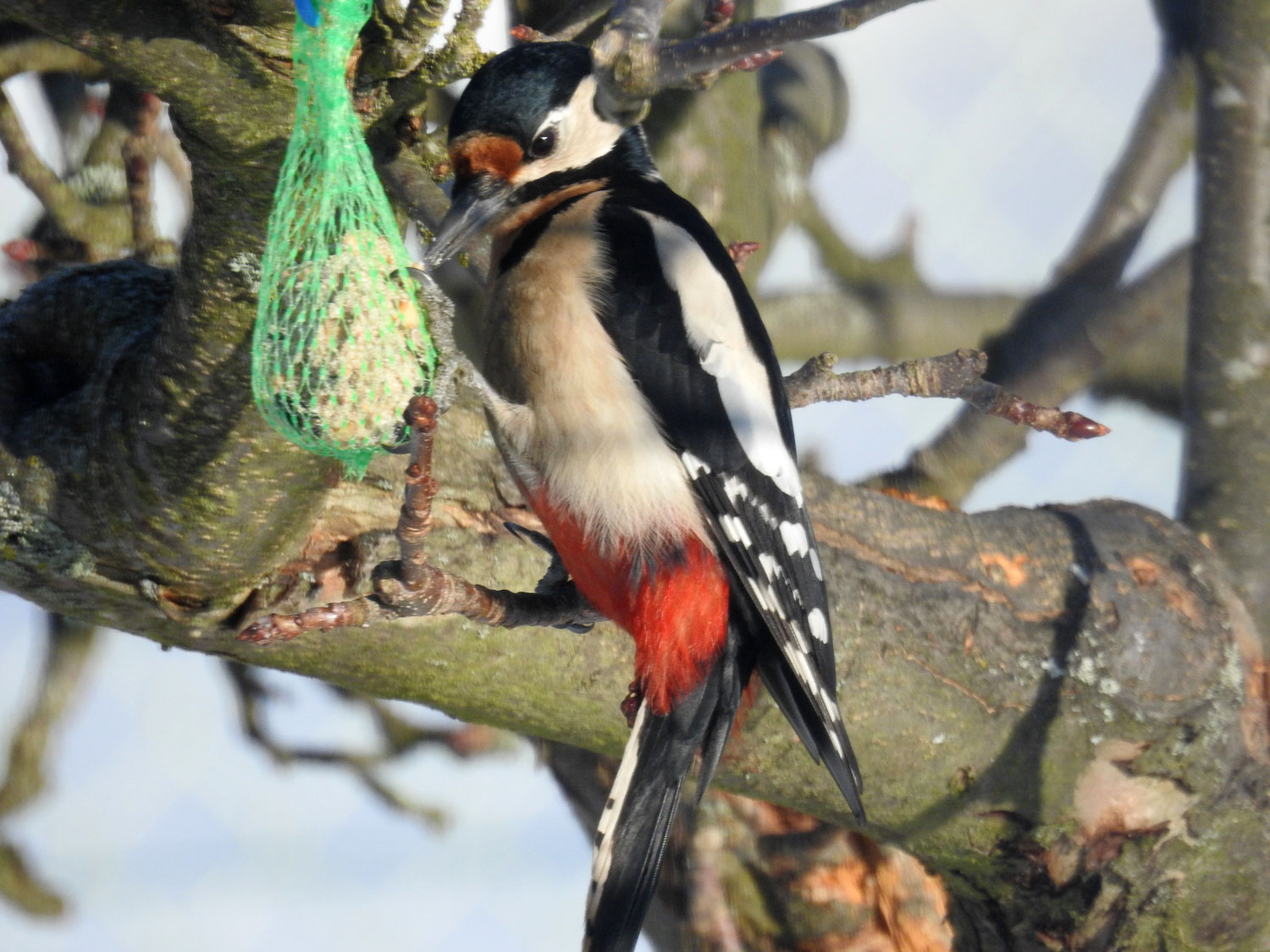
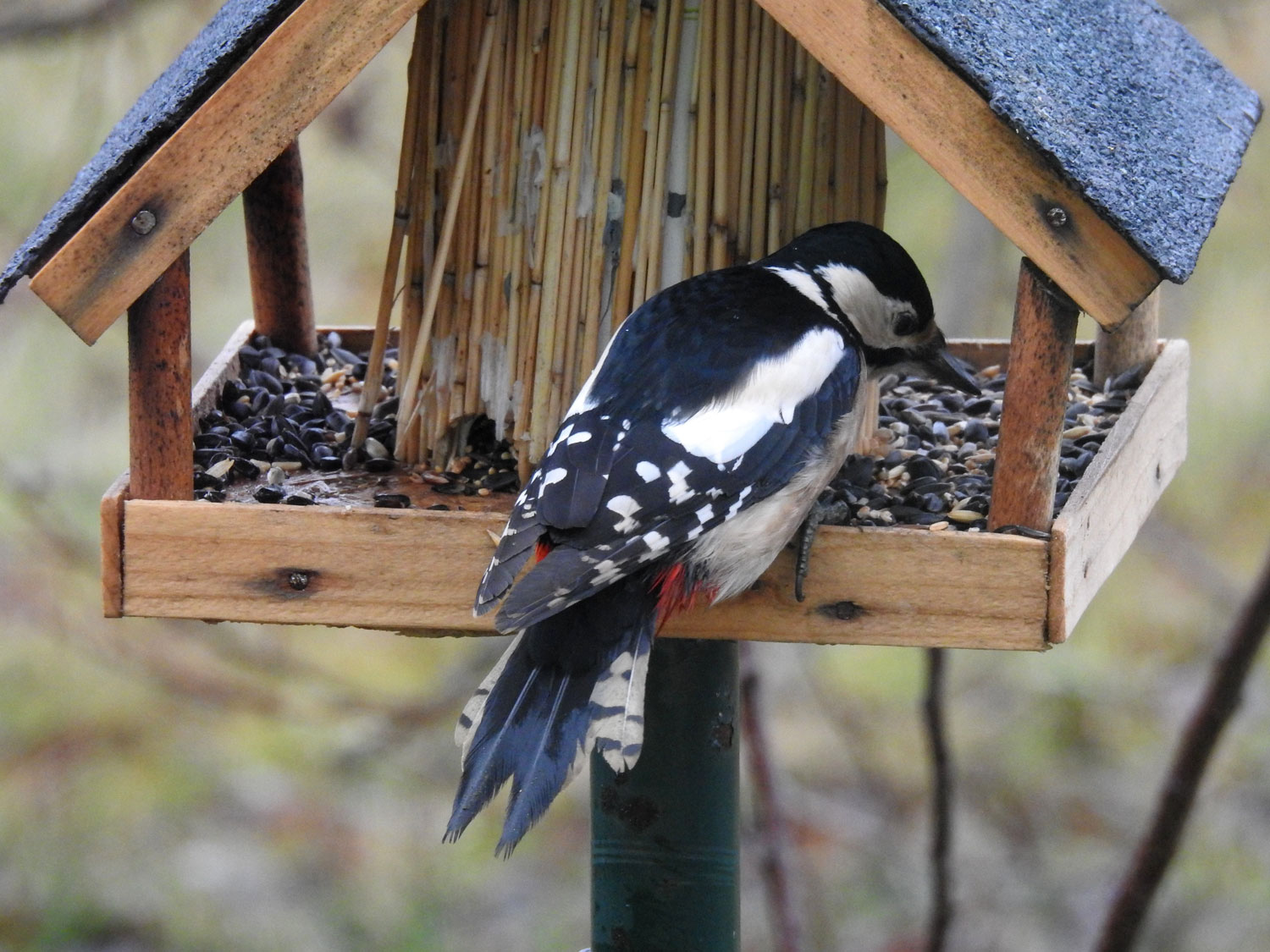
A Great Spotted Woodpecker, from Charly. Oh, she is so beautiful! Click for full size.



© Charly, all rights reserved.

© C. Ford.
The time of stench is now over, thankfully. So, I had a bit of time to play. Years ago, I wanted to experiment a bit. The experiment didn’t work out, but the paint was so beautiful. I found out then that I could peel it off the baking parchment paper I had used. I still have a number of those pieces. Watching paint dry might not be fun, but peeling it is. Have fun with acrylic paints (I suggest using baking parchment or the ever trusty freezer paper), let them surface dry, or as long as you want, then peel. Purty paint to play with results. This is also one way that paint doesn’t need to go to waste. Even very thin layers will peel, but the thicker your layer of paint, the easier the peel.

• February 16, 2017.

Donald Trump speaks to supporters at his Mar-a-Lago Club in Palm Beach, Florida. CREDIT: AP Photo/Gerald Herbert, File.
It’s a very old saying, the rich are different. It’s true, they are, by virtue of money, and the power money purchases. If they are different as people, it’s because money allows them to be arrogant, compassion free, unethical assholes without consequence. No, not every rich person on the planet is a truly shitty person, but they are rare birds in the flock of the rich. Rich people are accustomed to getting their way, using the time-honored method of greasing palms and opening doors with wedges of cash and promises. Now that we have someone in the white house who wouldn’t know an ethical behaviour if it bit him on the balls, the slime trail of the rich is visible from space.
According to a New York Times piece published on Saturday, Trump’s son Eric told the newspaper that Mar-a-Lago admits about 20 to 40 new members each year. Considering that Mar-a-Lago raised its initiation fees to $200,0000 after Trump’s presidential inauguration, that’s up to $8 million dollars coming in from new members per year. And that doesn’t include taxes or the $14,000 charge for each member’s annual dues.
Trump and his closest advisers have repeatedly denied there’s anything improper about Trump’s members-only club in Palm Beach. They say it doesn’t amount to paying for access to President Trump because the club is social, not political. And they argue the powerful people who pay for membership have other avenues of communicating with the president.
That’s an argument? I fail to see it.
“He has not and will not be discussing policy with club members,” White House spokesperson Holly Hicks said in a statement provided to the New York Times.
But reporting from the Times and from Politico suggests otherwise.
Real estate executive Bruce Toll told the New York Times that he does occasionally discuss national policy issues — specifically, Trump’s plans to increase spending on infrastructure projects — when he sees Trump at Mar-a-Lago. According to Toll, Trump sometimes receives advice from other club members about what he should do policy-wise.
Developer Richard LeFrak, a close friend of Trump’s, recounted a discussion at Mar-a-Lago last weekend during which Trump asked him for help with the proposed border wall between the United States and Mexico. Trump was unhappy with the projected cost of the wall, wanted to come up with a way to build it more cheaply, and suggested that the head of the Department of Homeland Security would give LeFrak a call to talk about it.
And according to an audio tape obtained by Politico from one of Trump’s New Jersey clubs that was also published on Saturday, Trump has asked his club members for their guidance selecting his cabinet appointees.
“We were just talking about who we [are] going to pick for the FCC, who [are] we going to pick for this, who we gonna accept — boy, can you give me some recommendations?” Trump said to a member, according to the tape.
[…]
This weekend, Trump is planning to use Mar-a-Lago to meet with potential candidates he’s considering to fill the National Security Adviser position recently vacated by Michael Flynn.
Of course, it’s not unusual for world leaders to surround themselves with rich and powerful people. But it is unique to be able to pay $200,000 for entry into a private club where multiple sources close to the president have confirmed he’s at his most relaxed and ready to mingle.
Applications to Mar-a-Lago have surged since Trump won the presidency.
Democratic lawmakers in both the House and the Senate have demanded more information about who holds a membership at Mar-a-Lago and how closely they have been vetted. The urgency increased after last weekend, when Trump and Japanese Prime Minister Shinzo Abe discussed a potential North Korea crisis in full view of the diners and waiters at his club.
Trump has spent the past three weekends at Mar-a-Lago even though he promised during the campaign that he would “rarely leave the White House.”
The system of government in the States has always been susceptible to corruption, it’s not the most well thought out system. I would say that no sitting president has ever been as open to corruption, and so willing to embrace it in full view of the public at large as the Tiny Tyrant. Donny isn’t capable of governing, he isn’t even capable of running a proper business, and hates being in the white house, acting as president. No, he only feels capable when he’s immersed in the foul cronyism of the monied, who he can slither over to for ‘advice’ on how to president, as he is utterly bankrupt when it comes to the little things, like intelligence, planning, and knowledge.
Via Think Progress.

From a Native American’s perspective, Trump is acting more like the Founding Fathers than Hitler.
Donald J. Trump has been called a lot of things. A bigot. A misogynist. A racist.
And I agree with these descriptions of the new president. He’s earned those titles, especially given all he has spewed over the decades about women and racial minorities, and just about anyone he disagrees with, or who disagree with him.
But Mr. Trump is also unoriginal.
Many of the controversial policies and plans he’s setting into motion have already been executed in this country.
Think about it.
Mr. Trump has vowed to evict millions of undocumented individuals. Brown folks, mostly.
But, of course, this wouldn’t be the first time a sitting U.S. president would forcibly and eagerly evict the indigenous peoples of this continent from their homes.
One of the first of such evictions in this country’s shady history occurred in the 19th century, back in 1830, when president Andrew Jackson signed the Indian Removal Act, which coercively extirpated thousands of Native Americans from their ancestral homelands.
The brutal act prompted the “Trail of Tears,” a vicious campaign that resulted in a forced westward march of men, women, and children through ice, snow, and freezing temperatures. More than four thousand Native Americans died during that rotten trudge.
“But Mexicans aren’t Indians,” a white man recently said to me at an eatery on the north side of Denver, Colorado, during an impromptu discussion on Trump’s unoriginality.
Religious Right bootstomper Carol Swain is quite upset about that dreaded gay thing. Specifically, her life is just being ruined, ruined I say, because some people might think she and a friend might be gay, oh no! I can’t even work up a response to this. Who the fuck cares? I’d assume people who actually know her know that she’s a bigoted piece of goods, along with her being hetero or whatever. Why would she care if strangers might have a random, passing thought about her? Not that I expect that happens much.
Last week, Religious Right activist and college professor Carol Swain spoke at the Family Research Council about her latest book, “Abduction: How Liberalism Steals Our Children’s Hearts and Minds,” where she complained that she cannot even go out in public with her female friends without worrying that people might think that they are gay.
[…]
Even now, as an adult, Swain complained that when she goes out in public with her female friends, “we have to wonder, do people think we’re gay?”
“We don’t care,” she said, “but just the fact that we live in a culture where you can’t have close relationships between men and women with women without wondering whether someone is going to think there is more to it, that is not the way society is supposed to operate.”
Oh yes, you do care. You care very much. After all, you have to have something to keep the edge of your unspeakable bigotry nice and sharp. You have to find yet another way to try and get small minded people panicky, so they’ll fork over money…to you. Convenient, that. I’m happily and visibly bisexual, and I don’t care if people think I’m hetero, nor do I care if they think I’m gay. Haven’t you heard, Carol? Love, it makes the world go ’round. You should try it sometime. Go ahead, go out with a friend, and hold her hand! It feels nice, especially when you don’t care what people think.
In Ms. Swain’s book, she opines about how when she was a little girl, she never had any thoughts about whether or not she might marry her best friend, and thinks openness and acceptance are just fucking everything up. That’s not the case, Ms. Swain. You didn’t think about marrying your best friend because she was a girl, and you were hetero. Other girls had a boy for a best friend, and if they were hetero, they may well have thought about marrying their best friend. Other girls thought about marrying their best girlfriend because they were not hetero. And so on. Y’see, everyone isn’t hetero, and you don’t get to use your personal experience to extrapolate a justification for oppression, bigotry and hatred.
Via RWW.

Gilles Cenazandotti Polar Bear, 2016.
Fusing a story of sustainability and animal welfare, the chromatic and playful sculptures fabricated from found objects ponder the future of the environment. Each of Gilles Cenazandotti‘s sculptures and assemblages are composed of polyurethane material culled from the Mediterranean Sea. The style of sauvegarde art, or safeguarding, is a unique environmental method that draws upon the French artist’s love for the environment and his love for forming art from unconventional materials. Formerly the head of a design company, the artist quit his day-job and sold the company four years ago in order to create detritus-amassed art.
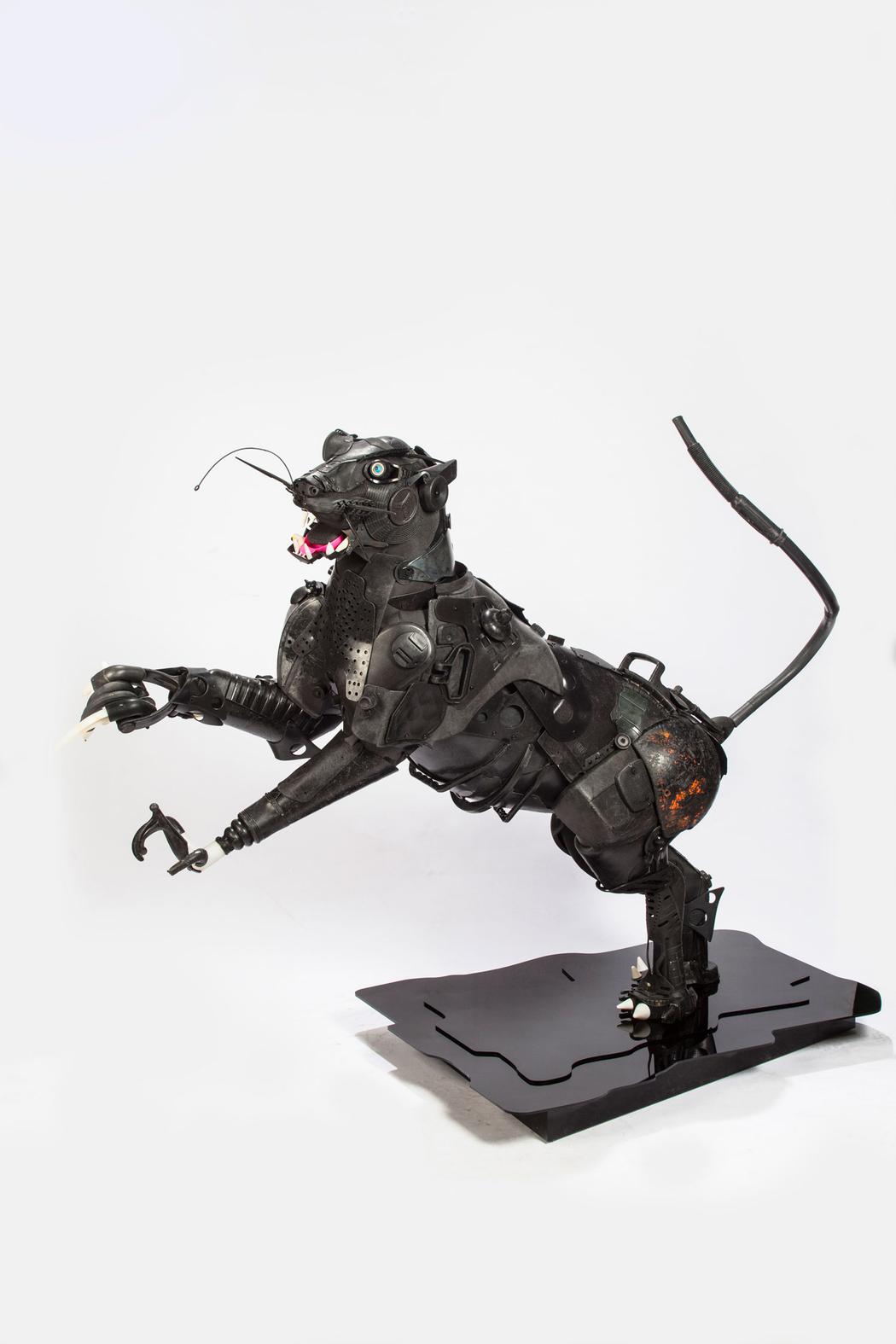
Gilles Cenazandotti Black Panther.
“I imagine this universe in my sculptures, of the cities moving to what is necessary to the survival of the men. What will it occur when the tide will overflow of our rejected products? When will pollution touch so many species that life will be decreased? This science fiction is near where one already sees the animals changing territory. One can wonder what they will become, like so many already disappeared species, if they do not find any more spaces to live.”

Gilles Cenazandotti Baboon, 2015.

Gilles Cenazandotti, Briquets Triptych , 2016. 47.25 x 11 inches each. Lighters Found from the Sea on Altuglass.
Remarkable work, and work with a very strong message. We need to stop being unthinking apes and be mindful humans. All of the work is deeply poignant, but it’s the lighters that get to me. FFS, is it that much to expect people to not treat our oceans like a convenient trash can?
Gilles Cenazandotti at Contessa Gallery.
Via The Creators Project.
