
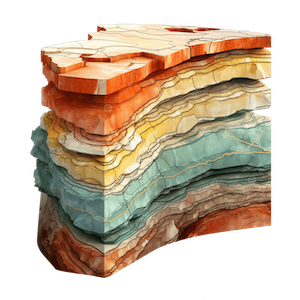
Today has been a day full of meetings (with another to come tonight!) and now I’m tired. One of the meetings gave me mixed feelings: a division meeting of all the science faculty to give our final approval of a decision to get rid of our geology discipline.
OK, that’s overly dramatic. We’re not actually getting rid of any of the geology classes, or any of the geology faculty, we just won’t be giving out geology degrees, and the existing structure of the discipline is getting folded into our Environmental Science program. Nothing will be lost, it’s more of an administrative shift, and apparently this is a common kind of change at many universities, but I still feel like it’s a historical break. Before there was a biology, there was geology, and geology was one of the core research fields in natural history. It’s being absorbed into a broader academic discipline, which is OK, I guess, but as an old guy I feel like something is being lost.
I wonder what will happen to biology in a few decades…what grander concept will expand to encompass my little domain?
Don’t tell me physics.

With Trump’s monstrous “drill, baby drill” sloganeering and its practical economic benefits, I’m surprised they’re stopping geology – would’ve thought that subject would be something in high demand with people being pushed towards it.
Thought it was the “soft” sciences not one as realtively hard as geology that would be under most attack…
Then again, there is the whole Christianist rejection of the reality of the age of earth – actual versus counting the biblical begats so there’s that.
But this isn’t political or cultural just administrative so, huh. Still surprises me.
Geomorphology with its focus on risks and impact of earthquakes, floods, volcanoes etc.. still being taught?
dianetics
engineering
or finance
I can’t help but think that this is a very bad idea. Geology is really about the history of the earth written in rock, and it has little intersection with other parts of the environmental sciences.
This is a grave mistake. It will lead to there being less geology experts who are really specialists on rocks.
We have provisions for students who want to specialize in pure geology.
Biology won’t be absorbed wholesale, it would be split. I am a postdoc at a big university (Canadian equivalent of an R1) which has a straight “Biology” department. Many of our peer universities already split it, usually along the lines of EEB and Molecular+Cellular. Even within our department, there are “research groups” that correspond to those divisions. But an EEB dept could theoretically be subsumed into Environmental Science, and an M+C into Biochem over in Faculty of Medicine.
But… There are enough PIs that span the gaps to avoid it for now. The “omics” people of various sorts that do evolution in wild systems stuff, the behavioural ecology people (big on molecular work), the development people who also do fossils, or the imaging people who work on cells one day but 3D geomorph of feeding morphology the next. I like it, we are all biologists in the end.
I think I hear a little peep out of Kentucky – “Floodology!”
Kind of weird when you think about it – whycome all the hyperchristians have started crawling out from under their rocks, except creationists?
“Geology is really about the history of the earth written in rock, and it has little intersection with other parts of the environmental sciences.”
I am not a geologist. Trust the opinions of a real geologist over anything that comes out of my head. That said: I think I disagree. I think there is a lot of geology in some of the other environmental sciences, just maybe not so much flow the other way. I took a hydrology of rivers course at university that was intimately intertwined with geology, for instance, though the geologists seemed to mostly care about our rivers as a way of looking at all the geology without having to dig a hole first.
@7 DaveH : “Biology won’t be absorbed wholesale, it would be split. … (snip).. usually along the lines of EEB and Molecular+Cellular.”
EEB = ???
Huh. I’d have thought biology would split along its field lines of botany, zoology, mycology then further into things like genetics, ecology, taxonomy, vetinary science, biochemistry, entomology, myriapodology, dendrology, mammology, arachnology (is that the word?), Paleobotany*, herpetology, ecology, bryology & lichenology, et cetera..
.* Come to think of it is Palaeontology itself biology or geology or a fusion of both?
I feel like I have both perspectives here – my undergraduate degree was in Environmental Science, and I minored in Geological Sciences (and given that there were geology courses required for an Environmental Science major, which I couldn’t actually use twice – for my minor too – I actually have taken quite a bit of undergrad geology). Just that you can do both things at the same time and they’re different speaks to a degree of separation between the disciplines. I also started (but did not finish) a Masters in Earth Sciece, and taught introductory geology courses for several years at a couple universities (classes with 50 to 200 students all looking to me as the expert…it was a little weird, but whatever, I enjoyed it a lot actually).
Anyway, environmental science is by its very nature an interdisciplinary (and to a certain extent, multidisciplinary) field. Within it, there are many academic sub-fields, from biology to geology to chemistry to biogeochemistry (which is actually mainly MICROBIOLOGY, if you can believe that, lol) that people choose to specialize in. They all know a bit about the others, but the very nature of academia is reductionism – even in a fundamentally holistic field like environmental science SHOULD be, it exists. As I was finishing my undergraduate degree in the Faculty of Science, my university had just created a new faculty, the Faculty of Environment, into which environmental science, geology and geography were being moved (geography from Arts, the other two from Science). All three degrees are offered independently of each other under the purvue of “Environment,” while in an environmental science degree, there remains a lot of sub-specialization that students have to choose, focusing on one thing while getting some experience in many things (I chose chemistry, as the sub-specialization pre-dated the move of faculties). And I think that’s a decent way to organize things, although I’m not sure it’s PRACTICALLY useful (plenty of employers want a Bachelor of Science degree, and studying in this faculty now, you’re getting a “Bachelor of Environment in Environmental Science/Geology/Geography” which is confusing to people…studying geology or environmental science, you’re still doing the work of a science degree, but it’s not called that anymore). So…I do think having a unique geology degree, one that graduates students who are elegible to become PROFESSIONAL geologists after taking a job and working for a few years (just like engineers, geologists have that option…as do environmental scientists, if they work in industry/government and not academia) is a useful thing to do. If the provisions that are being made for “pure geology” inclined students allow for this, that’s great, and there probably won’t be much of a difference….at least at first.
But in the long run, it could be problematic. It could prevent investment in geology at this university, making talented professors of geology go elsewhere, instead of Morris. And that might make some of the more advanced, niche courses that so few people take (like instrumental techniques in geology, where students do lab projects with ICP-MS, SEM, XRD, XRF, etc.) more expendable. That is if the university even has labs with that instrumentation to begin with (see: a lack of investment; self-fullfilling prophecy). And if it doesn’t…without academic geologists to USE that equipment (I mean, ICP-MS is used by chemists, so it might be used a lot, but the x-ray modalities especially are pretty geology and materal science-specific), I don’t see a future where anyone decides to BUY it, so that limits the kind of experiences students can have. Ultimately, the needs of geology students are different than the needs of environmental science students, and a small move like this could have big consequences in the future.
I’ve worked in a department that was split precisely along those lines — EEB and Cellular. It’s a very common division.
But then there was also a medical school, which is where all the money went. So a 3-way split?
It’s not like Wisconsin has interesting geology, like the western exposure of the Niagara Escarpment, glacial moraines, or the driftless area (as well as the rock layers below).
No geology?
Well, Dr. Sheldon Cooper would be proud.
[I recall Josh the Geologist from Titanoboa days]
You don’t have to worry about Biology getting absorbed into the Physics department because the Physics department is going to get split up between the Math and Mechanical Engineering departments.
The big shift in the Humanities over the last half century (at least in British universities, not sure whether the same is true of the US) has been the growth of culture-specific or period-specific degrees (Mediaeval Studies, Early Modern European Studies, Pre-Colonial African Studies), rather than splitting the content of these up into History, Literature, Anthropology, Art History etc. This is a path pioneered by my own discipline – Classics – a century and a half ago, and in the English-speaking world. Most of continental European academia still tends to treat Ancient History as the province of the History faculty, Greek and Roman literature as part of the Literature faculty, Classical Archaeology as part of the Archaeology faculty, Ancient Philosophy as part of the Philosophy faculty and so on.
A geology blogger and a Minnesota connection.
“How Agates Form, Why Minnesota Lakes Have So Many, & Where To Look For Them”
.https://youtube.com/watch?v=JKZ2VsXz8G0
Ecology and Evolutionary Biology
Happened at my uni. Two centres of excellence in geology. One in mantle geology the other in Palaeontology both gone. No more geology degrees. Palaeontology was temporarily saved when two professors retired and the other moved to biology. It is now about to go with the impending retirement of the sole professor. At its height palaeontology had three professors and an associate professor, around 35 research students and 5 research associates. This is not the only geology faculty to go Two other unis have no longer teach geology and there is only one left in the state where you can do a full geology major. This in a state and country where the major national income is from minerals and mining.
a university i taught physics at had the physics department swallowed up by the chemistry department.
and i just checked…they don’t have a physics degree anymore.
they DO have a biology program though!
(and Fashion Design…)
The geology department at my liberal arts university was constantly under threat of absorption by other sciences. Snip away one class here another class there, usually so that they could use ‘money saved’ to boost some humanities discipline that nobody was enrolled in.
The desperate-for-funding other science schools would claim they cover the same stuff. But they didn’t and they don’t. At my university such a promise of continuity for students who still wanted to specialize would be worth nothing.
Geology at Morris, RIP.
In my university, the Faculty of Science and Engineering is divided into four Schools: Mathematical and Physical Sciences, Natural Sciences, Computing, and Engineering. So if you end up following our lead (probably don’t!) you’ll find yourself with all of your Environmental Science and Chemistry.
@19. imback : “EEB = ???” Ecology and Evolutionary Biology.
Ah. Thanks. Much appreciated.