
The Probability Broach: Search and seizure

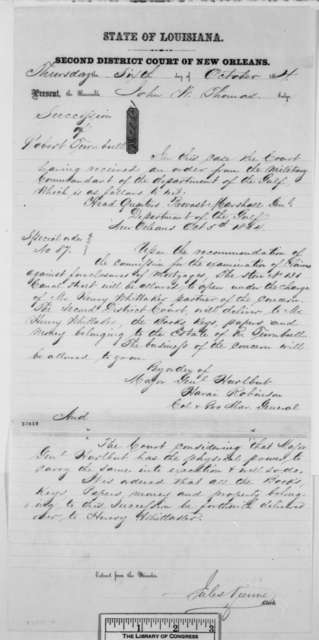
An official (handwritten) court order

The Probability Broach, chapter 15

This chapter opens with another of Smith’s fictional quotes put in the mouths of real historical figures. This one is attributed to Sequoyah (who in real life was the inventor of the Cherokee syllabary, but wasn’t an anarchist political theorist as Smith labels him).

“Are two people healthier than one person? Are two wiser? Then why believe they have more rights? History’s sadness is that sanity, wisdom, justice—the very qualities that make us human—are not additive, while one’s brute animal ability to do another injury, is. Two people are, tragically, stronger than one. Stripped to naked truth, that is the basis for all government, dictatorial or democratic. Can we not do better?”

—Sequoyah Guess
Anarchism Understood

Can two people be wiser than one? Yes! Was that even controversial?

It can go either way, to be fair. There’s such a thing as mob mentality, but there’s also such a thing as the wisdom of crowds. As a libertarian, you’d think Smith would be in favor of that: it’s always been proposed as an explanation for why free markets work, how it can be true that individual ignorance combines to produce a collectively rational result.

The wisdom of crowds is also why nations are governed by legislative bodies rather than kings, and criminal trials have a jury rather than leaving the verdict in the hands of a single random individual. There’s always a risk that one person will make a bad decision because of bias, ignorance or some other idiosyncratic reason. With a larger group, it’s more likely that individual prejudices and whims cancel each other out to produce a reliable result.

Back to the plot: Ed, Win and Lucy have assembled at Lucy’s house (“I’d counted eight cats so far, one sleeping in Lucy’s bony lap, another making his way up the difficult north face of Ed’s shoulder. I was trying to keep a kitten from perching on my head”) to discuss their meeting with John Jay Madison, a.k.a. Manfred von Richthofen, the Red Baron. It turns out Lucy remembers him from the Prussian war—they fought on opposite sides:

“The Red Knight of Prussia himself,” Lucy declared. “‘Twas his Flying Circus put me afoot back in thirty-eight. Never forget it—there we were: The Pensacola an’ the Boise flankin’ my Fresno Lady, bearin’ northeast outa Cologne. They—”

“But that’d make him at least—”

“Ninety-six,” Ed said.

(Lucy, meanwhile, is 136. The North American Confederacy has life-extension technology, so no one finds this odd.)

Win wants to know why Madison was addressing Lucy as “Your Honor”. She admits that she helps mediate an argument now and then for “catfood money”:

“Pay attention,” Ed warned, “she’s being modest. Lucy’s a highly respected adjudicator and member of the Continental Congress.”

… “A distinction,” Lucy intoned, “utterly without distinction. Congress hasn’t met in thirty years, and I’m hopin’ like crazy it won’t ever have to again.”

Ed and Win are hatching a plan to break into Madison’s place and search for concrete proof of his world-domination scheme. Since Lucy holds an official position with the NAC, Win asks if she could get them a search warrant, so they can do this in an above-board way. But, of course, she can’t:

“Winnie, I got no official capacity. Nobody does, not even the president of the Confederacy. She only rides herd on the Continental Congress, if and when… What you and Ed are planning is unethical, immoral, and—”

“Fattening?”

“I was about to say, illegal—if we were the legislatin’ kind, which we ain’t. You two get shot up in there, nobody’s gonna say a thing. Madison’ll be within his rights. Or, he could sue you right down to your bellybutton lint.”

“Well, what are we supposed to do while he’s taking over the planet?”

“Son, we gave up preventive law enforcement long before we gave up law.”

What Lucy is saying is that in the NAC, even if you have knowledge that someone is plotting a crime, there’s nothing you can do but stand by and watch until they actually commit it. Attempted murder isn’t an offense; only murder is. (This world runs on Sideshow Bob logic.)

In our world, if you’re shot and narrowly survive, there’d be a police report. You could describe the vehicle that the shots were fired from, testify that one of the attackers named someone named Madison as the ringleader. Detectives would collect forensic evidence from the scene. All of this would provide probable cause for a judge to grant a search warrant, which could either turn up further evidence or clear the suspect’s name.

Also, if the police find evidence that someone is planning a serious crime—let’s say, holding secret meetings where they discuss a plot to kidnap and kill a sitting governor—they can be arrested for that. (That’s called criminal conspiracy.)

You don’t have to sit on your hands and wait for a would-be criminal to actually hurt someone before anyone takes any action. Smith denigrates this as “preventive law enforcement”, but isn’t that what we should want? Police who prevent crime from happening, rather than just punishing the perpetrators after the fact?

Meanwhile, in the NAC, the protagonists can’t legally do anything at all. A criminal can plot their crime in exacting detail without having to fear any consequences. Even to investigate a serious crime that’s already occurred, you have to break the law by trespassing in the suspect’s home. (When police are outlawed, only outlaws will be police!)

Their only chance, as Ed explains, is to break in to Madison’s house and find something that retroactively justifies their doing so. He can sue them for burglary, but they can countersue for a bigger crime. He’ll end up owing them way more money, and potentially getting exiled if he can’t pay. Win describes this as, “The end justifies the means”—all things considered, a frightening attitude for a cop to hold.

This goes to show that “total freedom” isn’t a political position that benefits everyone equally. It’s a much bigger advantage for those with evil intentions.

The way that L. Neil Smith writes his anarcho-capitalist world, it’s not just that they don’t have police or law enforcement; it’s that the legal system actively forbids these activities, even if carried out by private parties. The ordinary evidence-gathering and investigating that law enforcement would normally engage in are against the law here. Anyone who attempts them is risking death or a punishing lawsuit.

Meanwhile, activities that would be serious felonies in our world are perfectly legal and allowable. You can recruit conspirators, plot crimes, threaten people, stockpile weapons—and nobody can do anything to stop you.

This is a good argument for the importance of the Hobbesian social contract. We all agree to surrender some freedoms, in exchange for the protection of a state that’s supposed to keep us safe from those who’d do us harm. Ironically, the plot Smith wrote furnishes a good illustration of why this bargain of civilization is worth making.

Image credit: Library of Congress

New reviews of The Probability Broach will go up every Friday on my Patreon page. Sign up to see new posts early and other bonus stuff!

Other posts in this series:
New on OnlySky: American brain drain

I have a new column this week on OnlySky. It’s about the scientific brain drain that’s overtaking America.

There’s an exodus of educated people currently taking place in the United States. Policy advisors and researchers with STEM degrees are leaving federal government jobs en masse, whether because of layoffs, budget cuts, or voluntarily quitting in protest of anti-scientific policies. Research scientists and professors are leaving the country entirely, heading for safer harbors like the EU, Canada or even China where they perceive they’ll find more stability and greater freedom for their work.

The consequences of this self-destructive politics will linger for a long time to come. Our policymaking will suffer for it, as the government loses its most qualified advisors. Scientific and technological progress won’t grind to a halt, but the U.S. will no longer be the place where it happens. Increasingly, we’ll be in the position of paying for discoveries made elsewhere, rather than being the ones to originate and profit from them.

Read the excerpt below, then click through to see the full piece. This column is free to read, but members of OnlySky also get special benefits, like member-only posts and a subscriber newsletter:

Whatever may happen in the future, the second Trump administration has done massive, long-lasting damage to the cause of science and technology in America. The federal government was once an ally to scientific research, but Trump and his cronies have turned it into an enemy.

They’ve turned anti-science wreckers loose at once-respectable institutions like the CDC, demolishing decades of evidence-based policy and rewriting scientific guidelines on a whim. They put a drug-addled sociopathic billionaire in charge of the federal workforce, firing thousands of workers according to his erratic whims. They’ve decimated budgets for basic research to give tax cuts to the rich and withheld federal grants to punish universities that don’t toe the line.

Last but certainly not least, Trump and his thuggish ICE stormtroopers are harassing and persecuting immigrants, and that includes immigrant scientists. Faced with the prospect of brutal arrests, violence and arbitrary detention, legal residents are making the rational choice to depart the country for safer harbors elsewhere.

Continue reading on OnlySky…

The Probability Broach: Who cares about the Bill of Rights?

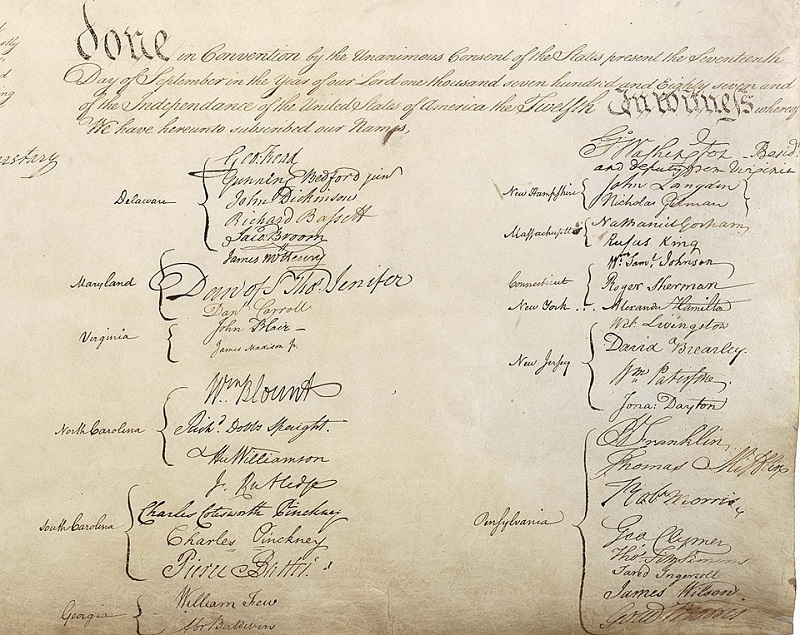
A close-up of the founders' signatures on the Constitution

The Probability Broach, chapter 14

Win, Ed and Lucy are face-to-face with John Jay Madison, the mastermind who’s responsible for the repeated assassination attempts that Win has been dodging ever since he arrived in this world.

And Madison doesn’t care whether they know it or not. Although he offers rote denials that he had anything to do with the attacks, he leers at them with superficial politeness that disguises barely concealed malice. He relishes the chance to taunt them, knowing they have no proof:

He rose, thrust his hands in his pockets, and paced, almost talking to himself, his eyes intent on some other place, some other time. “Inevitably, your investigations will reveal that my real name isn’t John Jay Madison. I was born Manfred, Landgraf von Richthofen. Quite a mouthful, isn’t it? It was, at one time, a name and family of some influence in Prussia, and of not inconsiderable wealth. The War changed that, of course. So, with perhaps a false start or two, I came to America to repair my fortunes.”

He spread his arms. “As you can see, I have, to a certain extent, accomplished that. I changed my name because John Jay and James Madison were, in my view, men of merit, of historical importance to both my homeland and this organization—certainly very American, something I was determined to become and rather easier to pronounce.”

He remarks that he almost named himself after Alexander Hamilton, but decided against it:

“I should have adopted his name, had I dared. I assure you it is held in the esteem it deserves, elsewhere in the System—still, I must be able to buy groceries without arousing counterproductive passions…

Though you may disagree with what I believe, nevertheless I insist on being allowed to believe it, unmolested.”

There’s a tension here which Smith alludes to, but doesn’t resolve.

On the one hand, he’s insistent that in the North American Confederacy, people have total freedom. Everyone can believe, speak and act as they see fit, so long as they don’t harm others. No one is harassed or oppressed because of their opinions. The vast majority of NAC citizens respect these implicit rights, even though there’s no law forcing them to do so.

On the other hand, in this passage, he admits (reluctantly?) that you can be so unlikable that people will ostracize you and refuse to do business with you. And as he said earlier, that’s effectively a death sentence in a society with no safety nets of any kind.

This shows that, even if the author doesn’t want to admit it, an anarcho-capitalist world wouldn’t be a haven of unfettered free speech. It would have a strong drive toward conformity. Everyone would have a natural incentive to fall in line with the dominant opinions of their community, their landlord, or their employer. Whoever you’re dependent on to supply you with the stuff of life, that person would have immense power over you. Why risk pissing them off by being a gadfly?

Arguably, a world with a comprehensive state safety net is more free for this reason. People can say what they wish, safe in the knowledge that their survival doesn’t depend on pleasing the nearest rich guy. No one can snap their fingers and deprive you of food, housing or health care. If there’s a mob at your door, there are (at least theoretically) police you can call who will come and protect you, even if they dislike you.

Some countries, though not the U.S., go even farther in the pursuit of individual rights by instituting employment contracts which guarantee that an employer can only dismiss you for good cause. You can’t be fired just because your boss doesn’t like your face.

Ostensibly to prove he has nothing to hide, Madison gives them a tour of his house—an enormous, rambling mansion that’s more like a museum. There are artifacts from wars and other political events through the decades that the Hamiltonians played a part in. Win notices one especially significant exhibit:

In a sort of chapel, spread like a Bible in a helium-filled glass altar, lay the Constitution of the United States. “We, the People, in order to form a more perfect Union…

There wasn’t any Bill of Rights.

This is a peculiar line for L. Neil Smith to include.

Obviously, readers are supposed to take this as further proof of Madison’s evil. He wants to conquer the world and impose centralized government, and he venerates the Constitution as symbolic of this. His (presumably deliberate) exclusion of the Bill of Rights shows that his hunger for power isn’t counterbalanced by any concern for people’s rights and freedoms.

But why does Smith think it makes any difference whether it’s there or not?

Lest we forget, Smith described the Constitution as a villainous conspiracy foisted upon an unconsenting nation. He denounced it as an intolerable infringement on freedom, so thoroughly corrupt that it couldn’t be reformed; it had to be scrapped and the country started over from scratch. Those who were responsible for writing it fared little better: George Washington was executed by firing squad, and Alexander Hamilton fled into disgraceful exile.

When you start from that perspective, why does it matter if there’s a Bill of Rights? He’s argued throughout this book that government is evil, full stop. But the fact that Madison, the actual villain of this novel, dislikes the Bill of Rights… doesn’t that imply that maybe the Constitution wasn’t as all-around bad as Smith wants us to think?

This is something he otherwise never concedes: that there can be degrees of government. Maybe, just maybe, it’s possible to have a government which actually values and protects its citizens’ rights, and this is preferable to a government which makes no such guarantees.

New reviews of The Probability Broach will go up every Friday on my Patreon page. Sign up to see new posts early and other bonus stuff!

Other posts in this series:
New on OnlySky: Protecting secularism in religious enclaves

I have a new column this week on OnlySky. It’s about how we can protect church-state separation in areas dominated by one particular sect of believers.

As religion declines all around the world, the most determined faith groups are retreating into their own isolated enclaves where they try to live apart from everyone else. This isn’t inherently a problem if it’s truly voluntary, but when a particular sect is the majority in one place, they very often try to punish outsiders and dissenters and write their beliefs into law.

Two such cases are playing out in America right now. In one town, an orthodox sect is trying to dismantle the public school system and force taxpayers to pick up the tab, creating a legal nightmare that could take years to untangle. But progress is possible, as seen in another pair of towns where democracy has triumphed and formerly oppressed cult members are emerging from theocratic darkness into the light.

Read the excerpt below, then click through to see the full piece. This column is free to read, but members of OnlySky also get special benefits, like member-only posts and a subscriber newsletter:

The idea of the Benedict Option is that Christians should (metaphorically or literally) retreat into the wilderness. They should pull back from a secular culture that they’ve failed to conquer, and isolate themselves in their own enclaves where they can live and raise their children as they see fit.

They frame this as keeping their morals and values intact. But the none-too-subtle implication is that they want to control everything their children see and hear. They want to ensure they don’t have to compete with pesky differing viewpoints. In that sense, it’s an admission that fundamentalist views can’t survive contact with diversity.

Obviously, the Benedict Option was proposed in a particular Christian context. Not everyone is taking their cues from this idea. But conservative religious communities of all kinds are independently following similar lines of thinking.

Continue reading on OnlySky…